
Last updated: April 2026
Key Facts
- State pension taxable percentage depends on year of retirement — 85.5% for 2026 retirees
- Rentenfreibetrag is fixed in euros in year 2 — pension increases are fully taxable
- Riester: deduct up to €2,100/year + state bonuses of €175 per adult and €300 per child
- Rürup: deduct up to €30,826/year — ideal for high-earning self-employed
- Private pension insurance: only the Ertragsanteil (17–22%) is taxable
- Altersentlastungsbetrag: 13.6% relief up to €646/year for those turning 64 in 2026
- Foreign pensions: generally taxable in Germany — declare on Anlage R-AUS
- Riester and Rürup payments in retirement are fully taxable — deferred taxation model
On this Page
Introduction
Pension tax in Germany is essential for anyone planning retirement here or receiving a pension while living in Germany. Pension income in Germany is subject to income tax — but not all of it, and not immediately. Germany uses a gradual taxation model that increases the taxable portion of your state pension depending on when you retired.
This guide explains how Germany taxes state pensions, Riester and Rürup pensions, private pensions and foreign pensions — and what deductions and reliefs are available to retirees.
How Germany taxes pension income: the gradual model
Germany introduced a fundamental reform of pension taxation in 2005 — transitioning from a system where only a small portion of pensions was taxable to one where pensions are eventually fully taxable. This transition happens gradually over decades.
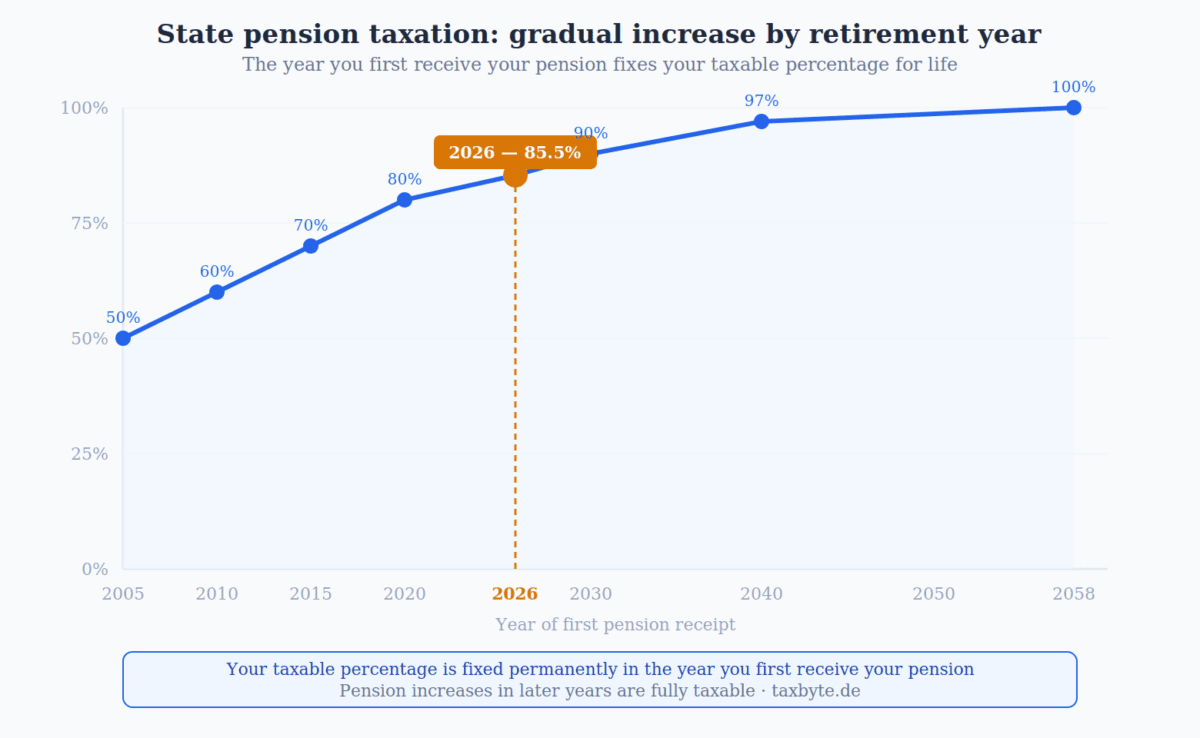
The key principle: the year you first receive your pension determines what percentage of it is taxable — for life.
The Kohortenregelung (cohort rule)
Each year of retirement entry has a fixed taxable percentage. This percentage applies to your pension for the rest of your life — it does not increase further once set.
| Year of first pension receipt | Taxable percentage |
|---|---|
| 2005 or earlier | 50% |
| 2010 | 60% |
| 2015 | 70% |
| 2020 | 80% |
| 2025 | 85% |
| 2026 | 85.5% |
| 2030 | 90% |
| 2040 | 97% |
| 2058 onwards | 100% |
Example: Helga retired in 2020. Her taxable percentage is fixed at 80% for the rest of her life. Her annual state pension is €18,000. Her taxable pension income is €14,400 (80% × €18,000). The remaining €3,600 is her tax-free Rentenfreibetrag — fixed permanently in euros in her second year of retirement.
Governed by: § 22 Nr. 1 EStG
The Rentenfreibetrag: your permanent tax-free amount
In the second year of receiving your pension, the tax office calculates your Rentenfreibetrag — the fixed euro amount of your pension that remains tax-free for life.
This is calculated as: (100% − taxable percentage) × annual pension in year 2
Once set, this euro amount stays fixed — it does not increase with future pension increases. This means pension increases in later years are fully taxable — a point many retirees miss.
Example continued: Helga’s annual pension in her second year of retirement is €18,200. Her Rentenfreibetrag is 20% × €18,200 = €3,640 — fixed for life. If her pension rises to €20,000 in year five, the extra €1,800 above her second-year base is fully taxable.
Governed by: § 22 Nr. 1 Satz 3 EStG
Do retirees need to file a tax return?
Many retirees assume they do not need to file a tax return. This is increasingly wrong — and the tax office is actively pursuing retirees who have not filed.
You must file if:
- Your total income exceeds the basic tax-free allowance (€12,348 in 2026)
- You receive income from multiple sources (pension + rental income, pension + part-time work)
- You receive a foreign pension alongside a German pension
- The Finanzamt requests a return
You should voluntarily file if:
- You have deductible expenses (medical costs, care costs, donations) that exceed standard amounts
- You paid too much tax at source on investment income
- You want to claim the Altersentlastungsbetrag or other reliefs
The Rentenberatungsstelle at your local pension office can help retirees understand their filing obligations for free.
Governed by: § 25 EStG
Riester pension: contributions and taxation
The Riester pension is a state-subsidised private pension scheme available to employees, civil servants and certain other groups. It combines tax deductions during the saving phase with state bonuses — but the pension payments are fully taxable in retirement.
Contributions and deductions
Annual Riester contributions are deductible as Sonderausgaben under § 10a EStG up to €2,100 per year (including the state bonus).
The tax office automatically checks whether the deduction or the state bonus is more beneficial — the Günstigerprüfung ensures you always get the better outcome.
State bonuses (Zulage)
- Basic bonus: €175 per year per contributing adult
- Child bonus: €300 per year for each child born from 2008 onwards, €185 for earlier children
- Young saver bonus: €200 one-time bonus for contributors under 25 when they start
Taxation in retirement
Riester pension payments in retirement are fully taxable at your normal income tax rate — this is the trade-off for the tax relief during the saving phase (called nachgelagerte Besteuerung — deferred taxation).
Important update: Riester is being replaced
The German government has announced that the Riester pension will be replaced by a new state-subsidised pension product — the Altersvorsorgedepot — from 2027. Existing Riester contracts will remain valid and continue to receive state bonuses under the current rules. New Riester contracts will no longer be available from 2027. If you are considering starting a Riester contract in 2026, weigh this carefully — the new Altersvorsorgedepot is expected to offer more flexible investment options and a reformed bonus structure. A dedicated cluster post will cover the Altersvorsorgedepot in full once the legislation is finalised.
Governed by: § 10a EStG, § 22 Nr. 5 EStG
Rürup pension (Basisrente): for the self-employed
The Rürup pension (also called Basisrente) is the self-employed equivalent of the state pension scheme — a private pension with significant tax advantages during the saving phase.
Contributions and deductions
Rürup contributions are deductible as Sonderausgaben under § 10 EStG. The maximum deductible amount for 2026 is €30,826 (single) or €61,652 (married, filing jointly). This ceiling covers all Basisversorgung contributions combined — meaning statutory pension contributions and Versorgungswerk contributions are counted toward it first, and the remaining headroom is available for Rürup.
This makes the Rürup pension one of the most powerful tax planning tools available to high-earning freelancers and self-employed professionals.
Taxation in retirement
Like the state pension, Rürup payments follow the gradual taxation model — the taxable percentage depends on when payments begin. For those starting payments in 2026, 85.5% is taxable.
Governed by: § 10 Abs. 1 Nr. 2 EStG
Company pensions (betriebliche Altersvorsorge): overview
Company pensions — where your employer contributes to a pension on your behalf, often with your own contributions redirected from gross salary — are a major part of the German pension landscape.
The tax treatment depends on the type of company pension scheme:
- Employer contributions up to 4% of the Beitragsbemessungsgrenze are tax and social insurance free during the saving phase
- Pension payments in retirement are fully taxable as employment income under § 19 EStG
For a full guide to the different company pension vehicles (Direktversicherung, Pensionskasse, Pensionsfonds, Direktzusage, Unterstützungskasse) see the company pensions cluster post →.
Governed by: § 19 EStG, § 3 Nr. 63 EStG (tax-free employer contributions)
Private pension insurance
Private pension insurance policies (private Rentenversicherung) that do not qualify as Riester or Rürup are taxed differently — only the income portion (Ertragsanteil) is taxable, not the full payment.
The Ertragsanteil depends on your age when payments begin:
| Age when pension starts | Taxable Ertragsanteil |
|---|---|
| 60 | 22% |
| 63 | 20% |
| 65 | 18% |
| 67 | 17% |
| 70 | 15% |
This makes private pension insurance relatively tax-efficient in retirement — only a small portion of each payment is taxable.
Governed by: § 22 Nr. 1 Satz 3 Buchst. a EStG
Foreign pensions received in Germany
If you live in Germany and receive a pension from another country, the treatment depends on the type of pension and the applicable tax treaty:
- State pensions from most countries → generally taxable in Germany as country of residence, subject to the gradual taxation model
- Government/civil service pensions → typically taxable only in the paying country under most treaties
- Private pensions → generally taxable in Germany
Foreign pensions must be declared in your German tax return on Anlage R-AUS. The Rentenberatungsstelle or a Steuerberater familiar with the relevant treaty is strongly recommended.
The Altersentlastungsbetrag: tax relief for over-64s
Taxpayers who turned 64 in the previous calendar year receive an additional tax relief — the Altersentlastungsbetrag. Under §24a EStG, the relief applies from the year after you complete your 64th year. So for the 2026 tax year, the relief is available to those who turned 64 in 2025 (born 2 January 1961 to 1 January 1962).
This reduces taxable income from certain income sources — but not from state pension, Riester/Rürup income, or Versorgungsbezüge.
Like the pension taxation model, the Altersentlastungsbetrag is being phased out gradually — the relief percentage and maximum amount decrease for each birth cohort, reaching zero in 2058.
For the 2026 tax year (those who turned 64 in 2025), the relief is 12.8% of qualifying income up to a maximum of €608 per year. Once set, your personal percentage and maximum are fixed for life.
Governed by: § 24a EStG
Pension contributions as Sonderausgaben
During your working life, contributions to pension schemes reduce your taxable income:
Statutory pension (Rentenversicherung): Employee and employer contributions to the statutory pension scheme are deductible as Sonderausgaben. For 2026 the maximum deductible amount is €27,566 (single) — contributions above this are not additionally deductible.
Riester: up to €2,100 per year including state bonus (§ 10a EStG)
Rürup: up to €30,826 per year (§ 10 EStG)
All three compete for the same overall Sonderausgaben pension deduction ceiling — they are not additive beyond the maximum.
Governed by: § 10 Abs. 1 Nr. 2 EStG, § 10a EStG
Key figures for pensions in 2026
| Item | Amount |
|---|---|
| Taxable pension percentage — retiring in 2026 | 85.5% |
| Maximum Riester deduction (incl. bonus) | €2,100/year |
| Riester basic bonus | €175/year |
| Riester child bonus (from 2008) | €300/year per child |
| Maximum Rürup deduction (single) | €30,826/year |
| Altersentlastungsbetrag — turned 64 in 2025 (applies in 2026) | 12.8% of qualifying income, max €608 |
| Basic tax-free allowance (Grundfreibetrag) | €12,348 |
Frequently asked questions
My state pension is below €12,348. Do I still need to file a tax return?
Not necessarily — if your only income is your state pension and it falls below the Grundfreibetrag after applying your Rentenfreibetrag, you may have no tax to pay. However if you have other income (rental, investment, part-time work) combined with your pension, you may still need to file.
I receive both a German state pension and a company pension. How are they taxed?
Both are added together as part of your total income. The state pension follows the gradual taxation model. The company pension is generally fully taxable as employment income. The combined total is taxed at your progressive income tax rate.
My Riester pension paid out less than I contributed. Do I still pay tax on it?
Yes — Riester payments are fully taxable regardless of whether the investment performed well. The tax relief you received during the saving phase is recouped through taxation of the payments.
I am a UK citizen receiving a UK state pension while living in Germany. Is it taxable in Germany?
Under the UK-Germany tax treaty, UK state pension is generally taxable in Germany as your country of residence. You must declare it in your German tax return on Anlage R-AUS. UK government pensions (civil service, military, teachers) are taxable only in the UK under the treaty.
Can I contribute to a Riester pension as a freelancer?
Generally no — Riester is only available to employees, civil servants and certain obligatorily insured groups. Freelancers and the self-employed should consider the Rürup pension instead.
Related Tax Guides
- Employee Taxes — pension contributions during employment
- Freelancers — Rürup pension for the self-employed
- Cross-Border & Expat Income — foreign pensions received in Germany
- Health & Disability — care costs and medical deductions for retirees
Related law pages on Taxbyte
- § 10 EStG — Pension contribution deductions (Sonderausgaben)
- § 10a EStG — Riester pension deduction and state bonus
- § 22 EStG — Pension income taxation
- § 22a EStG — Rentenbezugsmitteilungen — pension reporting to tax office
- § 24a EStG — Altersentlastungsbetrag for over-64s
- Official sources: § 22 EStG · § 10a EStG · § 24a EStG
Related Guides
This page explains German tax law in plain English for general information purposes. It is not legal or tax advice. Tax rules change annually — always verify figures against official sources or consult a Steuerberater for your specific situation.