
Last updated: April 2026
Key Facts
- Germany taxes expats’ worldwide income if tax resident here
- Double taxation treaties with over 100 countries prevent full double taxation
- Two relief methods: exemption (income excluded but affects rate) or credit (foreign tax offset against German bill)
- Exempt foreign income still triggers Progressionsvorbehalt — raising your German tax rate
- The 183-day rule protects temporary workers from German tax — 3 conditions must all be met
- Arriving mid-year: full Grundfreibetrag applies — often results in a refund
- Leaving Germany: file a return for the period of residence
- CRS and FATCA: foreign accounts are automatically reported — undeclared income is increasingly detectable
On this Page
Introduction
Expat taxes Germany: involve not just German domestic law but also international tax treaties, foreign tax credits, and special rules for people arriving, leaving or working across borders. For expats living and working in Germany — or for people earning income across multiple countries — the German tax system adds a significant layer of complexity.
The good news: Germany has double taxation treaties with over 100 countries, which generally prevent you from paying full tax twice on the same income. The challenge: understanding which country has the right to tax each type of income, and how the relief works in practice.
This guide explains the complete framework for cross-border and expat income taxation in Germany — in plain English, with real examples.
Germany’s right to tax: a quick recap
As covered in the German Tax Residency pillar, Germany’s right to tax depends on your status:
- Fully tax resident (unlimited tax liability under § 1 EStG) — Germany taxes your worldwide income
- Not tax resident (limited tax liability under § 49 EStG) — Germany taxes only your German-source income
For most expats living and working in Germany, unlimited tax liability applies — and this is where double taxation becomes a real issue.
Double taxation treaties (Doppelbesteuerungsabkommen — DBA)
Germany has concluded double taxation treaties (DBA) with over 100 countries. These treaties are bilateral agreements that determine which country has the primary right to tax each type of income — and how the other country provides relief.
Every treaty is different — the specific rules depend on the two countries involved. But most German treaties follow the OECD Model Convention and use similar principles for the main income categories.
What treaties cover
Most German DBAs allocate taxing rights for:
- Employment income — typically taxed where the work is performed
- Business profits — typically taxed where the permanent establishment is located
- Dividends — shared rights, with withholding tax at source and credit in residence country
- Interest — often taxed only in the residence country
- Royalties — often taxed only in the residence country
- Pensions — rules vary significantly by treaty
- Real estate income — typically taxed where the property is located
- Capital gains — varies by asset type and treaty
Governed by: § 2 AO (treaties override domestic law), individual DBA provisions
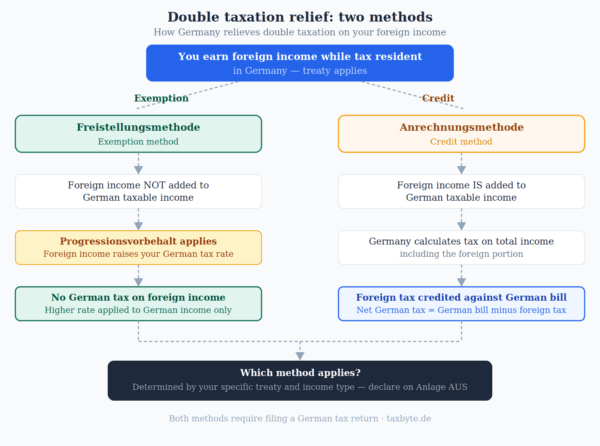
Two methods of double taxation relief
When Germany and another country both have a right to tax the same income, the treaty specifies which relief method applies. Germany uses two methods:
Method 1 — Exemption method (Freistellungsmethode)
The foreign income is exempt from German tax — it is not included in your German taxable income at all.
However — and this is critical — the exempt foreign income is still taken into account to determine your tax rate on your remaining German income via the Progressionsvorbehalt (§ 32b EStG).
This means: the foreign income does not get taxed in Germany, but it pushes up the rate applied to your German income.
Method 2 — Credit method (Anrechnungsmethode)
The foreign income is included in your German taxable income — Germany taxes it. But the foreign tax you already paid on that income is credited against your German tax bill.
The credit is limited to the German tax attributable to that foreign income — you cannot use a foreign tax credit to reduce your German tax on other income.
Governed by: § 32b EStG (Progressionsvorbehalt), § 34c EStG (foreign tax credit)
The Progressionsvorbehalt: exempt income that raises your rate
The Progressionsvorbehalt is one of the most misunderstood aspects of German expat taxation. It applies when foreign income is exempt from German tax under a treaty — but Germany still uses that income to set your tax rate.
Example: Priya is tax resident in Germany and earns €60,000 from her German employer. She also earns €20,000 from a rental property in India — exempt from German tax under the India-Germany treaty. Her German taxable income is €60,000. But the tax rate applied to that €60,000 is calculated as if her income were €80,000 — pushing her into a higher bracket. She pays German tax only on €60,000, but at the higher rate.
The Progressionsvorbehalt applies to:
- Exempt foreign employment income
- Exempt foreign business profits
- Certain tax-free German payments (Elterngeld, Arbeitslosengeld)
- Exempt foreign rental income
Filing is mandatory whenever the Progressionsvorbehalt applies — even if you would not otherwise need to file a German tax return.
Governed by: § 32b EStG
The 183-day rule in tax treaties
Most German tax treaties contain a 183-day rule for employment income. Under this rule, if an employee works temporarily in Germany while remaining employed by a foreign employer, Germany generally does not tax the employment income if:
- The employee spends fewer than 183 days in Germany in the relevant period (calendar year or 12-month period depending on the treaty)
- The salary is paid by — or on behalf of — an employer not resident in Germany
- The salary is not borne by a permanent establishment of the employer in Germany
If all three conditions are met, the employment income is taxed only in the employee’s country of residence.
Example: Marco is tax resident in Spain and works on a project in Germany for 120 days. His Spanish employer pays his salary with no German permanent establishment involved. Under the Spain-Germany treaty, his salary is not taxable in Germany — only in Spain.
Important: The 183-day rule applies to temporary work in Germany. If you live in Germany, you are tax resident here and the rule does not help you — your worldwide income is taxable regardless.
Cross-border commuters (Grenzgänger)
Grenzgänger are people who live in one country and work in a neighbouring country, returning home regularly — typically daily or weekly. Germany has special Grenzgänger provisions in several of its treaties, particularly with:
- Switzerland — the Swiss-German treaty has detailed Grenzgänger rules
- France — specific cross-border worker provisions
- Austria — cross-border commuter rules
Under most Grenzgänger provisions, the country of residence has the primary right to tax the employment income — not the country where the work is performed. This is an exception to the general rule that employment income is taxed where the work is done.
The specific rules — including what counts as a Grenzgänger, the geographic border zones, and the allocation of taxing rights — vary by treaty. See the country-specific cluster posts for detail.
Foreign employment income: when does Germany tax it?
If you are tax resident in Germany and work for a foreign employer — either remotely or by travelling abroad — Germany generally taxes your worldwide employment income.
However if a tax treaty exempts some of that income (for example because you physically worked in another country where your employer has a presence), the exemption method or credit method applies as described above.
Key scenarios:
Remote work for foreign employer from Germany: You are tax resident in Germany, working from home for a UK company. Germany taxes your salary — the UK company has no withholding obligation in Germany, so you must make advance tax payments and declare the income in your German return.
Secondment to Germany by foreign employer: Your foreign employer sends you to Germany for an assignment. If you become tax resident in Germany during the assignment, Germany taxes your worldwide income for that period.
Split employment across two countries: You work partly in Germany and partly abroad for the same employer. Germany generally taxes the portion attributable to work performed in Germany; the treaty determines how the cross-border portion is handled.
Foreign pension income
How foreign pensions are taxed in Germany depends heavily on the specific treaty and the type of pension:
- State pensions from most countries are covered by the treaty’s pension article — often taxed only in the country of residence (Germany if you live here)
- Government pensions (civil service, military) are typically taxed only in the country that pays them — even if you live in Germany
- Private pensions are usually taxed in the country of residence
Example: Helga receives a UK state pension while living in Germany. Under the UK-Germany treaty, UK state pension is generally taxable in Germany as her country of residence — she declares it in her German tax return.
The interaction between German pension taxation rules (§ 22 EStG) and treaty provisions is complex. A Steuerberater familiar with the relevant treaty is highly recommended.
Arriving in Germany mid-year
If you move to Germany during the calendar year, Germany taxes your worldwide income from the date you become tax resident — not from the start of the year.
For the period before you arrived, you are treated as a limited taxpayer (§ 49 EStG) for any German-source income you had during that period.
Practical points:
- You file a German tax return for the year of arrival
- Your basic tax-free allowance (Grundfreibetrag) is not reduced pro-rata — you get the full annual allowance
- This often results in a refund if you had German income withheld at source before becoming fully resident
Leaving Germany mid-year
If you leave Germany during the calendar year, Germany taxes your worldwide income for the period you were tax resident. From the date you leave (and give up your German home), you become a limited taxpayer for any remaining German-source income.
Key steps when leaving:
- Deregister your address (Abmeldung) — though note this alone does not end tax residency; you must also give up your home
- File a German tax return for the year of departure
- Notify your German broker(s) of your change of residence — withholding tax treatment may change
Exit tax warning: If you hold at least a 1% stake in any domestic or foreign corporation in your private assets, Germany may assess a deemed disposal tax on unrealised gains when you leave — the Wegzugsbesteuerung under § 6 AStG. The deemed sale is fictitious: no cash changes hands, but tax may still become due. Since 2025, this has also been extended to certain privately held investment fund units (including ETFs) where the holding meets minimum thresholds. This is a complex and actively evolving area requiring specialist advice well before any planned move.
📝 Expat — do you need to file a German tax return?
Answer 7 quick questions and find out — including whether your foreign income triggers a mandatory filing obligation.
Check if I need to file →Automatic information exchange: FATCA and CRS
Germany participates in two major international information exchange frameworks:
FATCA (Foreign Account Tax Compliance Act): US law requiring foreign financial institutions to report accounts held by US persons to the IRS. Germany-US IGA means German banks report US citizen and US person accounts to German tax authorities, who pass the data to the US.
CRS (Common Reporting Standard): The OECD’s global equivalent of FATCA. Over 120 jurisdictions exchange financial account information automatically each year, with more than 2,700 bilateral exchange relationships in place.
Practical implication: Do not assume undeclared foreign accounts or income will go undetected. The Finanzamt receives information automatically from most major financial centres — including Switzerland, Luxembourg, UK, Ireland, Singapore and many others.
Key points for expats filing in Germany
| Situation | What to do |
|---|---|
| Foreign employment income (exempt by treaty) | Declare in Anlage N-AUS — triggers Progressionsvorbehalt |
| Foreign investment income | Declare in Anlage KAP and Anlage AUS |
| Foreign rental income | Declare in Anlage V-AUS |
| Foreign pension | Declare in Anlage R-AUS |
| Arrived mid-year | File return — claim full Grundfreibetrag |
| Left mid-year | File return for period of residence |
| Foreign bank accounts | Declare if income generated — CRS means the Finanzamt likely knows |
Frequently asked questions
I work remotely for a UK company from my home in Berlin. Does the UK or Germany tax my salary?
Germany taxes it — you are tax resident in Germany and your work is performed in Germany. The UK has no right to tax employment income performed in Germany under the UK-Germany treaty. Your UK employer should not withhold UK income tax on your German-workdays salary.
I pay tax in two countries on the same income. What do I do?
Apply for relief under the relevant treaty. In Germany this means declaring the foreign income and claiming either the exemption (Freistellung) or the foreign tax credit (Steueranrechnung) on your German tax return using Anlage AUS.
My home country taxes my worldwide income too. Am I fully double-taxed?
Not if a treaty applies — the treaty allocates primary taxing rights and the other country provides relief. If no treaty exists, Germany provides unilateral relief under § 34c EStG — you can credit foreign tax against your German bill up to the German tax attributable to that income.
I am a US citizen living in Germany. Do I file in both countries?
Yes — US citizens must file US tax returns regardless of where they live (citizenship-based taxation). Germany taxes your worldwide income as a resident. The US-Germany treaty and the US Foreign Tax Credit generally prevent double taxation, but the interaction is complex. US expats in Germany should use a tax advisor experienced in both systems.
What is the difference between a tax treaty exemption and the foreign tax credit?
Under the exemption method, Germany does not tax the foreign income at all — but uses it to set your rate (Progressionsvorbehalt). Under the credit method, Germany taxes the foreign income but credits what you paid abroad. The exemption method is generally more favourable when the foreign tax rate is lower than Germany’s.
Related Tax Guides
- German Tax Residency — the foundation for all expat taxation
- Employee Taxes — employment income rules for expat employees
- Freelancers — cross-border freelancing and permanent establishment risks
- Special Income & Exits — exit tax when leaving Germany with assets
Related law pages on Taxbyte
- § 1 EStG — Tax residency and unlimited tax liability
- § 1a EStG — EU/EEA non-residents and the 90% rule
- § 32b EStG — The Progressionsvorbehalt
- § 34c EStG — Foreign tax credit§ 34d EStG — Definition of foreign income
- § 49 EStG — German-source income for non-residents
- § 50 EStG — Special rules for limited taxpayers
- Official sources: § 34c EStG · § 32b EStG · § 49 EStG
Related Guides
This page explains German tax law in plain English for general information purposes. It is not legal or tax advice. Tax rules change annually — always verify figures against official sources or consult a Steuerberater for your specific situation.