
Last updated: April 2026
Key Facts
- Freiberufler pay no Gewerbesteuer — the biggest tax advantage of liberal profession status
- Gewerbetreibende: Gewerbesteuer applies on profits above €24,500
- Advance tax payments due quarterly — 10 Mar, 10 Jun, 10 Sep, 10 Dec
- Set aside 30–40% of every invoice for tax and social insurance
- Home office flat rate: €6/day, max €1,260/year — no dedicated room needed
- VAT Kleinunternehmer threshold: €25,000/year — below this, opt out of VAT
- Health insurance: self-employed pay both employee and employer share
- EÜR accounting — simple cash method — available to all Freiberufler
On this Page
Introduction
Freelancer Taxes Germany: Going self-employed in Germany opens up significant tax complexity — but also real opportunities. Whether you are a freelancer such as a consultant, artist, engineer or therapist, or you run a trade business, understanding the German self-employment tax system from the start saves you from costly surprises.
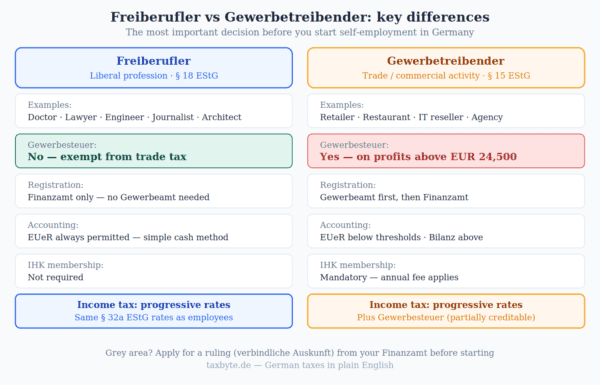
The most important decision you make before you start is whether you are a Freiberufler (liberal professional) or a Gewerbetreibender (trader) — because these two categories are taxed differently and have very different administrative obligations.
This guide covers everything self-employed people need to know about German taxes in simple terms.
Freiberufler vs Gewerbetreibender: the most important distinction
Germany divides self-employed activity into two fundamentally different categories. Getting this right from the start matters — because the tax and administrative consequences are very different.
Freiberufler (liberal professional)
A Freiberufler is someone who earns income from an independent professional activity based on personal expertise, creativity or science. The qualifying professions are defined in § 18 EStG and include:
- Scientific and academic professions: doctors, dentists, vets, lawyers, tax advisors, engineers, architects, chemists, psychologists
- Creative and artistic professions: writers, journalists, translators, artists, musicians, photographers
- Teaching professions: teachers, trainers, coaches (where the activity is personally delivered)
- Other liberal professions: pilots, notaries, surveyors
Key advantages of Freiberufler status:
- No Gewerbesteuer (trade tax) — this is the biggest financial benefit
- No Gewerbeanmeldung required — you register with the tax office (Finanzamt), not the trade office (Gewerbeamt)
- Simplified accounting — EÜR (income-surplus calculation) always permitted
Governed by: § 18 EStG
Gewerbetreibender (trader)
Anyone who earns income from a commercial, industrial or trading activity — buying and selling goods, running a restaurant, providing services that do not qualify as liberal professions — is a Gewerbetreibender.
Key implications of Gewerbetreibender status:
- Gewerbesteuer applies — trade tax on profits above €24,500
- Gewerbeanmeldung required — register with the local Gewerbeamt before starting
- More complex accounting — may need double-entry bookkeeping above certain revenue thresholds
The grey zone: Many modern professions — IT consultants, UX designers, social media managers — fall into a grey area. The Finanzamt decides case by case. If in doubt, apply for a ruling (verbindliche Auskunft) before you start.
Governed by: § 15 EStG
Registering as self-employed in Germany
For Freiberufler
- Fill in the Fragebogen zur steuerlichen Erfassung (tax registration questionnaire) on ELSTER or paper
- Submit to your local Finanzamt
- Receive your Steuernummer (tax number) — typically within 2–4 weeks
- No Gewerbeanmeldung needed
For Gewerbetreibende
- Register at the Gewerbeamt (trade office) — Gewerbeanmeldung
- The Gewerbeamt automatically notifies the Finanzamt
- Finanzamt sends you the tax registration questionnaire to complete
- Receive your Steuernummer
The tax registration questionnaire
This is a critical document. It asks for your expected income in the first year — which determines your initial advance tax payments. Be realistic — underestimating triggers a large year-end payment; overestimating means cash flow tied up in unnecessary prepayments.
Income tax for the self-employed
Self-employed income is subject to Einkommensteuer at the normal progressive rates — exactly the same rates that apply to employment income under § 32a EStG.
Your taxable profit is: Revenue − Betriebsausgaben (business expenses) = Taxable profit
The taxable profit is added to any other income you have (salary from a second job, rental income, etc.) and the combined total is taxed at your marginal rate.
Unlike employees, the self-employed have no employer withholding tax. You pay tax through advance payments (Vorauszahlungen) during the year and settle the final bill when you file your annual return.
Governed by: §§ 15, 18 EStG, § 32a EStG
🧮 Comparing employment vs freelancing?
Use the Net Wage Calculator to see what an equivalent salary would net after tax — useful when pricing your freelance day rate.
Open Net Wage Calculator →Profit calculation methods
Germany allows two methods for calculating taxable profit:
EÜR — Einnahmen-Überschuss-Rechnung (income surplus calculation)
A simple cash-based method: income received minus expenses paid = profit. Available to all Freiberufler and to Gewerbetreibende below certain revenue thresholds (€800,000 revenue or €80,000 profit per §141 AO).
Most freelancers use EÜR — it is straightforward and requires no double-entry bookkeeping.
Bilanzierung (double-entry bookkeeping)
Required for Gewerbetreibende above the EÜR thresholds, and for companies. More complex but provides a fuller picture of the business’s financial position.
Governed by: § 4 EStG (EÜR), § 5 EStG (Bilanzierung)
Deductible business expenses (Betriebsausgaben)
All expenses that are directly related to generating your business income are deductible as Betriebsausgaben. This is broader than the Werbungskosten available to employees.
Commonly deductible expenses:
Office and workspace:
- Home office — either the flat rate (€6/day, max €1,260/year) or a dedicated room (proportional share of rent, utilities, insurance)
- Rent for external office space — fully deductible
- Office furniture and equipment
Technology and communications:
- Computer, laptop, monitors — fully deductible if used primarily for business
- Mobile phone — the business-use proportion
- Internet connection — the business-use proportion
- Software and subscriptions
Professional development:
- Courses, certifications, conferences directly related to your work
- Professional books and publications
- Industry association memberships
Travel:
- Business travel — flights, trains, hotels
- Client visits — €0.30/km for car travel
- Commuting to a regular workplace — Entfernungspauschale applies
Marketing and client acquisition:
- Website costs
- Advertising
- Business cards and stationery
- Client entertainment (75% deductible)
Professional services:
- Tax advisor fees
- Legal fees
- Accountant fees
Insurance:
- Professional liability insurance (Berufshaftpflicht)
- Business-related insurance premiums
Governed by: § 4 Abs. 4 EStG
Trade tax (Gewerbesteuer)
Gewerbesteuer is a municipal business tax that applies only to Gewerbetreibende — not to Freiberufler. This is the main financial reason why Freiberufler status is so valuable.
How Gewerbesteuer is calculated
- Start with your taxable profit
- Add back certain items (e.g. 25% of interest payments above €100,000)
- Deduct the Gewerbesteuer-Freibetrag of €24,500 for sole traders and partnerships
- Multiply the remaining amount by the Steuermesszahl of 3.5%
- Multiply by your municipality’s Hebesatz (multiplier) — typically 200%–500% depending on location
The effective Gewerbesteuer rate varies significantly by municipality — Munich charges 490%, Berlin 410%, smaller towns often 200–300%.
Important relief: Gewerbesteuer paid is partially credited against your income tax bill under § 35 EStG — reducing (but not eliminating) the double taxation effect.
Example: Marco runs a marketing consultancy classified as a Gewerbe in Hamburg (Hebesatz 470%). His profit is €80,000. After the €24,500 exemption: €55,500 × 3.5% × 4.70 = €9,128 in Gewerbesteuer. This is partially credited against his income tax.
Governed by: Gewerbesteuergesetz (GewStG), § 35 EStG (income tax credit)
Advance tax payments (Vorauszahlungen)
The self-employed pay income tax (and Gewerbesteuer if applicable) in quarterly advance payments — on 10 March, 10 June, 10 September and 10 December each year.
The amounts are set by the Finanzamt based on your previous year’s tax bill. In your first year, they are based on your estimated income from the registration questionnaire.
Why this matters:
- If your income grows significantly, your advance payments may be too low — leading to a large year-end payment plus interest
- If income falls, you can apply to reduce your advance payments mid-year
- Setting aside 30–40% of every invoice for tax is the standard advice for new freelancers
Governed by: § 37 EStG
📝 Freelancer — do you need to file a tax return?
Answer 7 questions and get a clear answer on your filing obligation — including whether you need Accountable or Sorted for VAT returns.
Check if I need to file →Health and pension insurance for the self-employed
This is one of the most significant financial obligations for the self-employed in Germany — and one that surprises many expats.
Health insurance
The self-employed must arrange their own health insurance. Two options:
Statutory health insurance (GKV): You pay the full contribution yourself — both the employee and employer share. In 2026 the combined rate is 17.5% of your income (14.6% base rate + 2.9% average Zusatzbeitrag), applied up to the contribution ceiling of €5,812.50/month (€69,750/year). At the ceiling, the maximum GKV+Pflege contribution is approximately €1,261/month for self-employed without children.
Importantly, a minimum contribution applies regardless of how little you earn. The Mindestbemessungsgrundlage for 2026 is €1,318.33/month — meaning even if your actual income is lower, contributions are calculated on this base. The resulting minimum GKV+Pflege payment is approximately €260–278/month. This catches many new freelancers off guard in their first low-income months.
Private health insurance (PKV): Fixed monthly premium regardless of income. Can be significantly cheaper for healthy younger freelancers but carries risks — premiums rise with age and returning to GKV is difficult.
Pension insurance
Freiberufler are generally not required to contribute to the statutory pension scheme (Deutsche Rentenversicherung) — though some professions (artists, certain teachers, craftspeople) are subject to mandatory pension contributions via special schemes like the Künstlersozialkasse (KSK).
Gewerbetreibende are also generally exempt from mandatory pension contributions — but this means building your own retirement provision is entirely your responsibility.
VAT (Umsatzsteuer): overview
Most self-employed people in Germany must register for VAT and charge it on their invoices. The standard rate is 19%, with a reduced rate of 7% for certain goods and services.
The Kleinunternehmerregelung (small business rule) allows businesses with revenue below €25,000 net in the previous calendar year to opt out of VAT entirely. A second hard limit also applies: if revenue exceeds €100,000 in the current calendar year at any point, Kleinunternehmer status ends immediately from the transaction that crosses the threshold — not at year-end. Both limits must be observed at all times. Below them, no VAT is charged, no VAT returns are filed, and no input tax can be reclaimed.
For a complete guide to VAT for freelancers — registration, invoicing rules, quarterly returns, input tax reclaim and the Kleinunternehmer rule in detail — see the VAT for freelancers cluster post →.
Governed by: Umsatzsteuergesetz (UStG)
Key figures for the self-employed in 2026
| Item | Amount |
|---|---|
| Gewerbesteuer exemption (sole traders) | €24,500 profit |
| Advance tax payment dates | 10 Mar · 10 Jun · 10 Sep · 10 Dec |
| Home office flat rate | €6/day, max €1,260/year |
| Client entertainment deductibility | 75% of costs |
| VAT standard rate | 19% |
| VAT reduced rate | 7% |
| Kleinunternehmer VAT threshold | €25,000/year |
| GKV health insurance rate (approx.) | 14.6% + additional contribution |
Frequently asked questions
I am employed and want to freelance on the side. Is this allowed?
Generally yes — Germany allows side-line self-employment alongside employment. However check your employment contract for any exclusivity clauses. Your freelance income is added to your salary and taxed at your marginal rate. If your freelance profit exceeds €410, you must file a tax return.
I am an IT consultant. Am I a Freiberufler or Gewerbetreibender?
It depends on the nature of your work. IT consultants performing creative or scientific work — software architecture, development, systems analysis — can qualify as Freiberufler under § 18 EStG. Purely commercial IT activities — reselling, support — are typically Gewerbe. The Finanzamt decides case by case. Many IT freelancers successfully register as Freiberufler.
Do I need a German bank account to freelance?
Not legally required — but practically essential. German clients and the Finanzamt expect German bank details on invoices. Most business accounts at German banks or fintechs (N26, Penta, Qonto) work well for freelancers.
When do I need to start charging VAT?
If your revenue exceeded €25,000 net in the previous calendar year, you cannot use the Kleinunternehmerregelung in the current year. If your revenue crosses €100,000 in the current calendar year, your Kleinunternehmer status ends immediately — from the invoice that pushes you over the threshold, not at year-end. Below both limits, you can opt out of VAT entirely.
I work for clients abroad. Do I charge German VAT?
For B2B services to EU clients, the reverse charge mechanism applies — you do not charge German VAT; the client accounts for VAT in their country. For non-EU clients, German VAT generally does not apply. Rules are complex — see the VAT cluster post for detail.
Related Tax Guides
- German Tax Residency — residency and tax obligations for expat freelancers
- Capital Income & Investing — investment income alongside freelance profits
- Rental Income & Property — rental income combined with freelance income
- Special Income & Exits — selling your business, GmbH exits
Related law pages on Taxbyte
- § 15 EStG — Trade and business income (Gewerbetreibende)
- § 18 EStG — Liberal professions (Freiberufler)
- § 4 EStG — EÜR profit calculation method
- § 5 EStG — Double-entry bookkeeping (Bilanzierung)
- § 35 EStG — Gewerbesteuer credit against income tax
- § 37 EStG — Advance tax payments (Vorauszahlungen)
- Official sources: § 18 EStG · § 15 EStG · § 37 EStG
Related Guides
This page explains German tax law in plain English for general information purposes. It is not legal or tax advice. Tax rules change annually — always verify figures against official sources or consult a Steuerberater for your specific situation.