
Last updated: April 2026
Key Facts
- Severance pay: claim the Fünftelregelung — spreads tax over 5 years, saves thousands
- Selling company shares (≥1%): only 60% of gain is taxable (Teileinkünfteverfahren)
- Private property sales: tax-free after 10 years — timing your sale matters enormously
- Stock options: taxable at vesting/exercise — § 19a deferral available for startup employees
- Inheritance: €400,000 per child tax-free, resets every 10 years — plan early
- Lottery winnings: completely tax-free in Germany
- Exit tax: leaving Germany with a 1%+ company stake may trigger immediate tax on unrealised gains
- Compensation for personal injury: tax-free under § 3 EStG
On this Page
Introduction
Most German tax guides focus on regular income — salary, rent, dividends. But some of the most significant tax events in a person’s life are one-off — a redundancy payment, a business sale, an inheritance, a stock option vesting, or leaving Germany permanently.
Special income tax Germany on these events follows different rules — and often offers specific reliefs that can significantly reduce the tax burden if you know how to use them. This guide explains every major category of special and one-off income in Germany in plain English.
Other income (§ 22 EStG): the catch-all category
§ 22 EStG is Germany’s residual income category — it covers income that does not fit into the other six categories. Key types of other income include:
- Recurring payments and annuities — not covered by pension rules
- Private sales profits — gains from selling assets within the speculation period (§ 23 EStG)
- Alimony received — under certain conditions
- Certain compensation payments
- Income from occasional activities — one-off services not qualifying as self-employment
Governed by: § 22 EStG
Severance pay and the Fünftelregelung
Severance pay (Abfindung) is one of the most common forms of special income in Germany. When you receive a large one-off payment — a redundancy package, a settlement, or compensation for loss of employment — it creates a spike in your income that could push you into a much higher tax bracket than normal.
Germany addresses this with the Fünftelregelung (one-fifth rule) under § 34 EStG — a mechanism that significantly reduces the tax impact of large one-off payments.
How the Fünftelregelung works
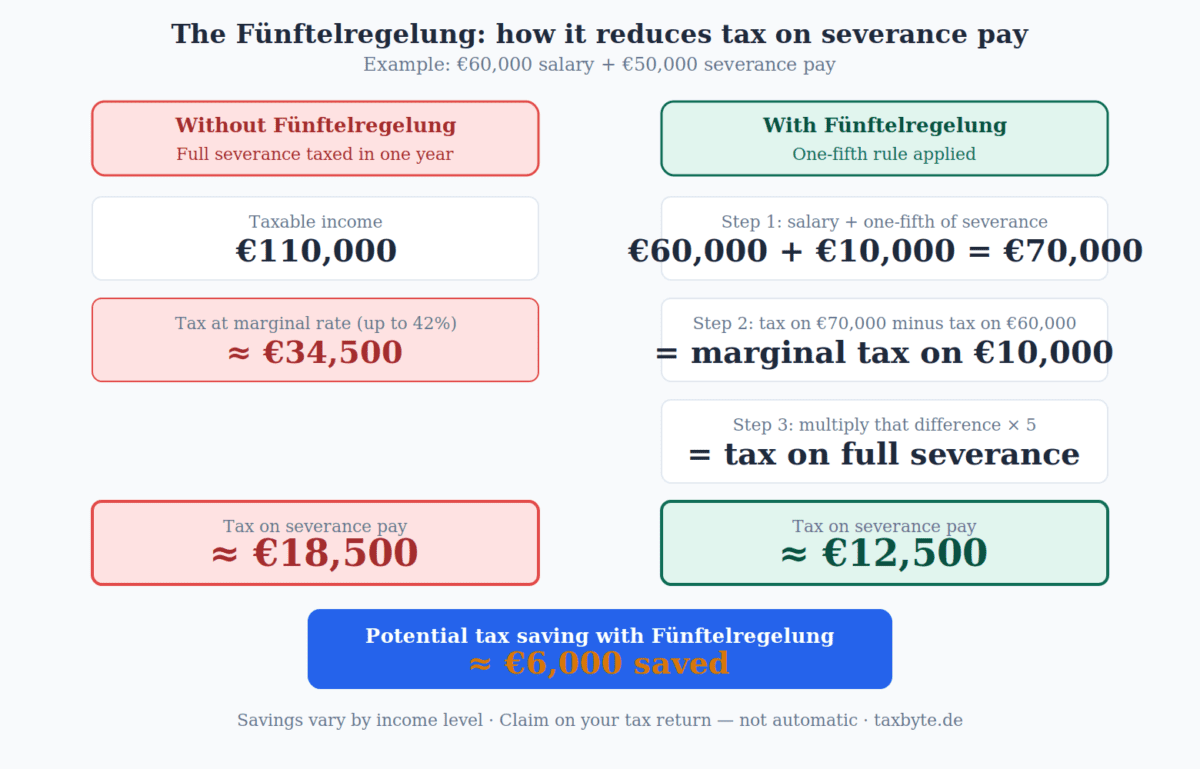
- Take the exceptional income (e.g. severance pay of €50,000)
- Divide it by five (€10,000)
- Calculate the tax on your normal income plus one-fifth of the exceptional income
- Calculate the tax on your normal income alone
- The difference × 5 = the tax on the exceptional income
This effectively taxes the exceptional income as if it were spread over five years — reducing the bracket effect significantly.
Example: James earns €60,000 salary and receives €50,000 severance pay. Without Fünftelregelung his total income would be €110,000 — taxed at up to 42%. With Fünftelregelung: tax on €60,000 + €10,000 (one-fifth) = tax on €70,000, minus tax on €60,000 = marginal tax on €10,000 × 5 = tax on the severance at effectively a much lower rate. The saving can be several thousand euros.
When does the Fünftelregelung apply?
The relief applies to außerordentliche Einkünfte (extraordinary income) — income that is:
- Genuinely exceptional and not part of normal recurring income
- Paid in a single year (concentration principle — Zusammenballung)
It applies to severance pay, certain business sale proceeds, back-pay for multiple years, and compensation for loss of rights.
Important: The Fünftelregelung is not automatic — you must claim it in your tax return.
Governed by: § 34 EStG
Selling shares in a company (§ 17 EStG)
If you own at least 1% of a GmbH or AG and sell your shares, the gain is taxed as income — not as capital income under the flat 25% Abgeltungsteuer, but as regular income under the progressive rates.
However a 40% exemption applies under the Teileinkünfteverfahren — only 60% of the gain is taxable. Correspondingly, only 60% of any related costs are deductible.
The gain is calculated as: Sale proceeds − Purchase price − Selling costs = Gain Taxable gain = 60% of gain
Example: Priya sells her 5% stake in a Berlin startup for €200,000. She paid €20,000 for it. Her gain is €180,000. Under the Teileinkünfteverfahren, 60% = €108,000 is taxable at her marginal rate. At 42%, her tax on the gain is approximately €45,360 — versus €47,475 without the partial exemption.
Governed by: § 17 EStG
Private sales: the speculation period (§ 23 EStG)
As covered in the Rental Income pillar, gains from selling private assets within a certain holding period are taxable as speculative gains:
- Real estate: taxable if sold within 10 years of purchase (unless primary residence)
- Other assets (art, collectibles, foreign currencies, crypto held under 1 year): taxable if sold within 1 year of purchase
- Annual exemption: gains below €1,000 per year from all private sales combined are tax-free — note this is a Freigrenze, not a Freibetrag: if your total gains reach €1,000 or above, the entire amount becomes taxable, not just the excess
Speculative gains are taxed at your normal progressive income tax rate — not the flat 25%.
Governed by: § 23 EStG
Stock options and equity grants (§ 19a EStG)
Stock options and equity grants from your employer are a form of employment income — taxable when they vest or are exercised, not when they are granted.
Germany introduced a deferral mechanism under § 19a EStG in 2021 (reformed in 2024) for employees of qualifying startups and SMEs: the tax on equity income can be deferred for up to 15 years or until a triggering event (sale of shares, leaving the company, IPO) — whichever comes first.
How § 19a EStG works
Without deferral, employees pay income tax on the value of equity at vesting — even if they cannot sell the shares immediately (the “dry income” problem). With § 19a EStG deferral:
- Tax is deferred until the shares are actually sold or a triggering event occurs
- The employer must apply to the Finanzamt for the deferral
- Qualifying companies must meet size and age criteria
When equity income is taxable
Without § 19a deferral, equity income is taxed as employment income at your marginal rate in the year of vesting or exercise. The taxable amount is the fair market value of the shares at that point minus any amount paid by the employee.
Governed by: § 19 EStG, § 19a EStG
Inheritance and gift tax: overview
Inheritance tax (Erbschaftsteuer) and gift tax (Schenkungsteuer) are governed by the Erbschaftsteuergesetz (ErbStG) — separate from the EStG income tax law. However they are closely related to income tax planning and highly relevant for expats and property owners in Germany.
Key principles
Who is liable:
- If the deceased or the heir is tax resident in Germany, German inheritance tax applies to the worldwide estate
- If neither is resident but the estate includes German assets (property, German company shares), German inheritance tax applies to those assets only
Tax-free allowances (Freibeträge)
Germany provides generous tax-free allowances that reset every 10 years:
| Relationship | Tax-free allowance |
|---|---|
| Spouse / registered partner | €500,000 |
| Child | €400,000 |
| Grandchild | €200,000 |
| Parent (on inheritance) | €100,000 |
| Siblings, nieces, nephews | €20,000 |
| Unrelated persons | €20,000 |
Tax rates
Above the allowance, rates range from 7% to 50% depending on the relationship and the value of the inheritance:
- Class I (spouse, children, grandchildren): 7%–30%
- Class II (siblings, parents on gifts, step-children): 15%–43%
- Class III (unrelated persons): 30%–50%
Primary residence exemption
A property used as the primary family home is completely exempt from inheritance tax if:
- Inherited by the spouse or registered partner — no conditions
- Inherited by children — if they actually live in it for at least 10 years after inheritance
For a complete guide to inheritance and gift tax planning in Germany — including the 10-year gifting strategy and international estates — see the inheritance and gift tax cluster post →.
Governed by: ErbStG
Exit tax: leaving Germany with assets (Wegzugsbesteuerung)
If you leave Germany permanently and you own at least 1% of a company that was subject to German taxation, Germany may assess a deemed disposal tax on unrealised gains — as if you had sold your shares on the day you left.
This is the Wegzugsbesteuerung under § 6 AStG (Außensteuergesetz — external tax law).
When it applies
- You held at least 1% of a domestic or foreign company at any point in the 10 years before departure
- You were tax resident in Germany for at least 7 of the last 12 years
- The shares have unrealised gains
Relief options
- If you move to another EU/EEA country, payment can be deferred interest-free until the shares are actually sold
- If you move to a non-EU/EEA country, the tax is generally due immediately — though instalment payment arrangements may be available
- Double taxation treaties may provide further relief
Example: Priya has been tax resident in Germany for 8 years and holds a 3% stake in a Berlin startup worth €500,000 (original cost: €20,000). She decides to move back to India. Germany assesses exit tax on the unrealised gain of €480,000 — at 60% under the Teileinkünfteverfahren, €288,000 is taxable. The tax bill could exceed €100,000 — due immediately since India is not an EU/EEA country.
Governed by: § 6 AStG
Lottery winnings and gambling income
Lottery winnings in Germany are generally tax-free — winnings from the state lottery (Lotto), Eurojackpot, and licensed gambling operations are not subject to income tax.
However income from professional gambling — if classified as a commercial activity — may be subject to income tax and Gewerbesteuer.
Interest earned on lottery winnings held in a bank account is taxable as capital income in the normal way.
Compensation payments
Compensation payments received for:
- Loss of employment — covered by the Fünftelregelung if qualifying
- Personal injury — generally tax-free under § 3 Nr. 1 EStG
- Loss of rights or property — may be taxable as extraordinary income under § 24 EStG
- Insurance payouts for damage to property — generally tax-free to the extent they replace the damaged asset
Governed by: § 3 EStG (exemptions), § 24 EStG (compensation for loss of income)
Key figures for special income in 2026
| Item | Amount / Rule |
|---|---|
| Fünftelregelung — applies to | Extraordinary income concentrated in one year |
| § 17 share sale — taxable portion | 60% of gain (Teileinkünfteverfahren) |
| § 17 threshold — minimum shareholding | 1% of company capital |
| Private sale speculation period — property | 10 years |
| Private sale speculation period — other assets | 1 year |
| Annual exemption (Freigrenze) for private sales | €1,000 (entire gain taxable if exceeded) |
| § 19a equity deferral period | Up to 15 years |
| Inheritance tax — spouse allowance | €500,000 |
| Inheritance tax — child allowance | €400,000 |
| Exit tax threshold — minimum shareholding | 1% |
| Exit tax — years of residency required | 7 of last 12 years |
Frequently asked questions
I received a redundancy payment of €80,000. How much tax will I pay?
It depends on your other income and whether the Fünftelregelung applies. If you were made redundant as part of a genuine restructuring, the Fünftelregelung almost certainly applies — reducing your effective tax rate on the payment significantly. Claim it on your tax return — it is not applied automatically by your employer.
I sold my flat after 9 years. Is the gain taxable?
Yes — you are within the 10-year speculation period. The full gain (sale price minus purchase price minus costs) is taxable at your marginal income tax rate. Had you waited one more year, the gain would have been completely tax-free.
My employer gave me stock options. When do I pay tax?
At the point of exercise (for options) or vesting (for restricted shares) — not when granted. The taxable amount is the market value at that point minus any amount you paid. If your employer qualifies under § 19a EStG, the tax may be deferred until you sell.
I am leaving Germany and moving to the UK. Will I face exit tax?
Possibly — if you hold at least 1% of a company and have been resident for 7+ of the last 12 years. The UK is no longer an EU/EEA country post-Brexit, so deferral is not automatically available. Seek specialist advice well before your planned departure date.
Are gifts from my parents taxable in Germany?
Gifts are subject to Schenkungsteuer — but the generous allowances (€400,000 per child every 10 years) mean most family gifts fall below the threshold. Gifts below the allowance are completely tax-free with no filing obligation.
Related Tax Guides
- Capital Income & Investing — share sales below the 1% threshold
- Rental Income & Property — property sales and the 10-year rule
- Freelancers — business closure and sale
- Cross-Border & Expat Income — exit tax and leaving Germany
Related law pages on Taxbyte
- § 17 EStG — Selling shares in a GmbH or AG
- § 19a EStG — Equity and stock option deferral for startup employees
- § 22 EStG — Other income: the catch-all category
- § 23 EStG — Private sales and the speculation period
- § 34 EStG — The Fünftelregelung for extraordinary income
- Official sources: § 34 EStG · § 23 EStG · § 17 EStG
Related Guides
This page explains German tax law in plain English for general information purposes. It is not legal or tax advice. Tax rules change annually — always verify figures against official sources or consult a Steuerberater for your specific situation.