
Last updated: April 2026
Key Facts
- Students living in Germany are fully tax resident — worldwide income is taxable
- Minijob limit in 2026: €603/month — no income tax or social insurance for you
- Werkstudent privilege: work up to 20 hours/week during semester with reduced social insurance
- First-degree study costs: deductible up to €6,000/year as Sonderausgaben
- Second-degree study costs: no cap — carry-forward loss to future employment years
- BAföG is completely tax-free — no need to declare it
- Kindergeld: €259/month — no income limit for students since 2012
- Filing voluntarily almost always results in a refund if Lohnsteuer was withheld
On this Page
Introduction
Being a student in Germany does not automatically mean you are exempt from tax. Whether you work alongside your studies, receive financial support, or plan to claim your study costs back from the tax office — understanding how German tax law applies to students can save you real money.
This guide covers everything students need to know about student taxes in Germany — from Minijobs and working student rules, to study cost deductions, BAföG, and your first German tax return — in plain English.
Are students tax resident in Germany?
If you live in Germany as a student — whether in a student hall, shared flat, or your own apartment — you are almost certainly fully tax resident in Germany. This means Germany taxes your worldwide income, not just income earned in Germany.
The same residency rules that apply to everyone apply to students. If you have a home in Germany, you are tax resident here — regardless of your nationality, visa status, or whether you are enrolled at a German university.
For a full explanation of tax residency rules see the German Tax Residency pillar →.
Working students: how your income is taxed
Most students in Germany earn income alongside their studies. How that income is taxed depends on how much you earn and how you work.
Minijob (up to €603 per month in 2026)
A Minijob is the most common way students earn money in Germany. The earnings limit for a Minijob is €603 per month from 1 January 2026, which equals €7,236 per year. Minijob-Zentrale
Key rules for Minijobs:
- No income tax is deducted from your wages — your employer pays a flat-rate contribution to the state instead
- No social insurance contributions for you as the employee (health, unemployment, care insurance)
- Pension insurance applies unless you opt out — students often opt out, but opting in builds pension entitlements
- You do not need to declare Minijob income in a tax return unless you have other income sources
A Minijob is ideal for students who want simple, low-administrative employment alongside their studies.
Governed by: § 40a EStG (flat-rate taxation of Minijobs)
Working student (Werkstudent) — above €603 per month
If you earn more than €603 per month, you move out of Minijob territory. As a Werkstudent (working student), your income is subject to normal Lohnsteuer withholding — but with an important social insurance privilege.
The Werkstudentenprivileg means that as long as you work no more than 20 hours per week during semester time, you are exempt from unemployment insurance contributions, and your employer is released from their health and care insurance contributions on your behalf. Only pension insurance applies to your payslip. You still need to be health insured separately — either through your parents’ family insurance (up to age 25) or through the student health insurance tariff (studentische Krankenversicherung). This combined effect means your take-home pay as a Werkstudent is significantly higher than that of a regular part-time employee earning the same amount.
This makes the Werkstudent arrangement very attractive for students who want to earn more without the full social insurance burden of a regular employee.
Example: Lena studies computer science in Berlin and works 18 hours per week for a startup at €15 per hour. Her monthly gross is around €1,170 — well above the Minijob limit. As a Werkstudent working under 20 hours during semester, she pays income tax and pension contributions, but no unemployment insurance. Her employer also pays no health or care insurance contributions on her behalf. Lena herself remains covered through student health insurance separately. The result: her net pay is significantly higher than a regular part-time employee earning the same amount.
Governed by: § 19 EStG, SGB V § 6 (Werkstudentenprivileg in social insurance law)
Midijob (€603.01 to €2,000 per month)
If you earn between €603 and €2,000 per month, you are in the Übergangsbereich (transitional zone), also called a Midijob. You pay reduced social insurance contributions on a sliding scale — more than a Minijob but less than a full employee. Income tax applies normally.
Study costs: can you deduct them?
This is one of the most important — and most misunderstood — areas of student tax law in Germany.
First degree (Erstausbildung)
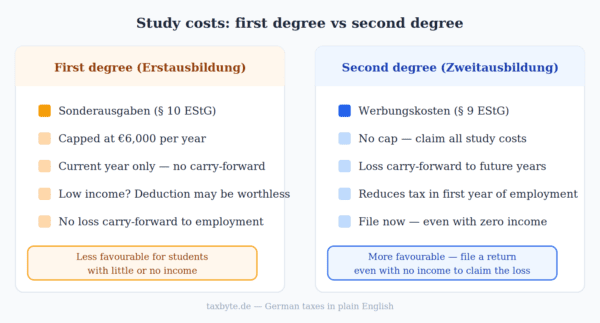
If you are studying for your first degree or first vocational qualification, your study costs are treated as Sonderausgaben (special personal expenses) under § 10 EStG — not as work-related expenses. This matters because:
- Sonderausgaben can only reduce your taxable income in the current year
- They cannot be carried forward to future years as a loss
- If you have little or no income as a student, the deduction may provide no benefit at all in the year you study
The maximum deduction for first-degree study costs is €6,000 per year.
Second degree or further qualification (Zweitausbildung)
If you are studying for a second degree — for example a Master’s after a Bachelor’s, or a university degree after completing a vocational Ausbildung — your study costs qualify as Werbungskosten (work-related expenses) under § 9 EStG.
This is significantly more valuable because:
- Werbungskosten can exceed your income, creating a Verlustvortrag (loss carry-forward)
- The loss is carried forward to future years when you start earning — reducing your tax bill then
- There is no annual cap on Werbungskosten deductions
Example: Lena finishes her Bachelor’s and starts a Master’s degree. She has no income during her Master’s year but pays €8,000 in tuition, study materials and semester fees. These qualify as Werbungskosten. She files a tax return showing a loss of €8,000. This loss carries forward and reduces her taxable income in her first year of employment — potentially saving her over €3,000 in tax.
Governed by: § 9 EStG (Werbungskosten), § 10 EStG (Sonderausgaben), § 12 EStG (non-deductible private expenses)
Ausbildung (vocational training): how is it taxed?
Students doing a vocational training programme (Ausbildung) are treated similarly to employees for tax purposes. Your Ausbildungsvergütung (training allowance) is employment income under § 19 EStG and subject to Lohnsteuer withholding.
Key points for Auszubildende:
- Your training company withholds Lohnsteuer based on your tax class
- The basic tax-free allowance of €12,348 (2026) means most trainees pay little or no income tax — training allowances are typically below this threshold
- You can deduct work-related expenses including commuting costs, work equipment and professional books
- Your Ausbildung counts as a first vocational qualification — meaning a subsequent degree qualifies for the more favourable Werbungskosten treatment
For a deep dive into Ausbildung-specific tax rules, deductions and the tax return process see the Ausbildung taxes cluster post →.
BAföG: is it taxable?
BAföG (Bundesausbildungsförderungsgesetz) is the German state student grant and loan system. The good news for students receiving BAföG:
- BAföG payments are completely tax-free — they are not added to your taxable income
- You do not need to declare BAföG in your tax return
- BAföG does not trigger the Progressionsvorbehalt (unlike Elterngeld or Arbeitslosengeld)
However BAföG does affect your parents’ entitlement to Kindergeld (child benefit) — the rules depend on your total income from all sources during the year.
Kindergeld and the annual income limit
If you are under 25 and in full-time education or training, your parents may receive Kindergeld (child benefit) for you — currently €259 per month in 2026.
There is no income limit for students receiving Kindergeld — a rule that was abolished in 2012. However, one important restriction applies after you complete your first qualification (Erstausbildung): if you are in a second degree or further training and simultaneously work more than 20 hours per week in regular employment, your parents’ Kindergeld entitlement stops — not because of how much you earn, but because of how many hours you work. As long as you stay within 20 hours per week (as most Werkstudenten do), Kindergeld continues regardless of your income.
However if you complete your studies or training and do not immediately start a new qualification, Kindergeld stops. There are specific rules for gap years, job searching periods and transition times between qualifications.
Governed by: § 32 EStG (child status for tax purposes), § 63 EStG (Kindergeld eligibility)
When must students file a tax return?
Many students assume they do not need to file a tax return. This is sometimes true — but often wrong, and filing is almost always worth it.
You must file if:
- You worked for multiple employers simultaneously
- Your non-Minijob income exceeded the basic allowance (€12,348 in 2026)
- The tax office requests a return
You should voluntarily file if:
- You worked part of the year and Lohnsteuer was withheld — you will almost certainly get a refund because your annual income was below the tax-free threshold
- You have study costs to declare (especially second-degree Werbungskosten for the loss carry-forward)
- You had commuting costs, work equipment or other deductible expenses
- You worked only part of the year
The loss carry-forward strategy: Even if you have zero income and nothing to refund, filing a tax return to establish a Verlustvortrag for your second-degree study costs is highly worthwhile. The Finanzamt confirms the loss and carries it forward automatically.
Governed by: § 25 EStG, § 46 EStG
Key figures for students in 2026
| Item | Amount |
|---|---|
| Basic tax-free allowance (Grundfreibetrag) | €12,348 |
| Minijob earnings limit | €603 per month / €7,236 per year |
| Werkstudent hours limit (semester) | 20 hours per week |
| Maximum first-degree study cost deduction | €6,000 per year |
| Second-degree study costs (Werbungskosten) | No cap — carry-forward available |
| Kindergeld per child (2026) | €259 per month |
| Employee flat-rate deduction | €1,230 per year |
Frequently asked questions
I only worked a Minijob this year. Do I need to file a tax return?
No — Minijob income is taxed at source by your employer. You do not need to declare it. However if you have other income sources (freelance work, investments) you may still need to file.
Can I deduct my laptop as a student?
Yes — if you use it primarily for your studies. A laptop used for study qualifies as a study cost. For second-degree students it is a Werbungskosten deduction with no cap. For first-degree students it counts toward the €6,000 Sonderausgaben limit.
I am an international student. Do German tax rules apply to me?
Yes — if you live in Germany, you are tax resident here regardless of your nationality. German tax law applies to your worldwide income. EU students and non-EU students are treated the same for income tax purposes.
My parents receive Kindergeld for me. Does my income affect this?
Since 2012 there is no income limit for Kindergeld. Your parents receive it as long as you are under 25 and in education or training. One exception applies after your first qualification: if you are in a second degree and work more than 20 hours per week in regular employment, the entitlement stops. Working under 20 hours — as most Werkstudenten do — has no effect on Kindergeld.
What is the difference between a Minijob and a Werkstudent job?
A Minijob pays up to €603 per month and has simplified tax and social insurance rules. A Werkstudent job pays more but requires you to work under 20 hours per week during semester to keep the social insurance privilege. Both are popular with students — the right choice depends on how much you want to earn.
Related Tax Guides
- Family Taxes — Kindergeld for adult students, parent deductions
- Employee Taxes — when students also work alongside studying
Related law pages on Taxbyte
- § 9 EStG — Work-related expenses: what students can deduct
- § 10 EStG — Special deductions including first-degree study costs
- § 12 EStG — Non-deductible private expenses
- § 19 EStG — Employment income including Ausbildungsvergütung
- § 32 EStG — Child status and Kindergeld eligibility
- § 40a EStG — Flat-rate taxation of Minijobs
- § 46 EStG — When employees and students must file a tax return
- Official sources: § 9 EStG · § 10 EStG · § 32 EStG
Related Guides
This page explains German tax law in plain English for general information purposes. It is not legal or tax advice. Tax rules change annually — always verify figures against official sources or consult a Steuerberater for your specific situation.