
Last updated: April 2026
Key Facts
- Kindergeld: €259 per month per child — applies to all children equally from 2026
- Kinderfreibetrag: €9,756 per child — Germany automatically applies whichever is better
- Ehegattensplitting: married couples split combined income — biggest benefit when incomes are unequal
- Single parent relief: €4,260/year for first child + €240 for each additional (Tax Class II)
- Childcare deduction: 80% of costs, up to €4,800 per child per year for under-14s
- Elterngeld is tax-free but triggers mandatory tax return filing
- Kindergeld age limit: up to 25 if child is in education or training
- Apply for Kindergeld at the Familienkasse — it is not automatic
On this Page
Introduction
Navigating family taxes in Germany is one of the most rewarding areas of the German tax system — having children changes your situation significantly, and usually in your favour. Germany’s tax system offers a range of benefits for families: monthly child benefit payments, generous child allowances, joint filing advantages for married couples, and special relief for single parents.
But the rules are layered and often misunderstood — especially for expat families, EU citizens, and couples with very different incomes. This guide explains every major family tax benefit in Germany with real numbers for 2026.
Kindergeld: Germany’s child benefit payment
Kindergeld is a monthly cash payment made to parents for each child. It is the foundation of Germany’s family support system and the starting point for understanding family taxes.
How much is Kindergeld in 2026?
From 2026, Kindergeld is €259 per month per child — for the first, second, third and every additional child. The previous tiered system (where the third and fourth child received more) was abolished in 2023.
Who qualifies for Kindergeld?
To receive Kindergeld you must:
- Be fully tax resident in Germany (unlimited tax liability under § 1 EStG) or treated as such under § 1a EStG
- Have a child who meets the eligibility criteria (see below)
Governed by: § 62 EStG (eligibility), § 66 EStG (amount)
Which children qualify?
A child qualifies for Kindergeld if they are:
- Under 18 — automatically, no conditions
- 18 to 25 — if in education, vocational training, or registered as unemployed and seeking work
- Any age — if the child has a disability that prevents them from supporting themselves financially
Governed by: § 63 EStG, § 32 EStG
Kindergeld for expat families
EU citizens living and working in Germany are generally entitled to Kindergeld on the same basis as German citizens. For non-EU expats, entitlement depends on your residence permit type — most work permit holders qualify.
If your child lives in another EU country while you work in Germany, you may still receive Kindergeld — but the amount may be reduced by any equivalent child benefit paid by the child’s country of residence.
Governed by: § 62 EStG, EU Regulation 883/2004
Kinderfreibetrag: the child tax allowance
Alongside Kindergeld, every parent is entitled to a Kinderfreibetrag — a tax-free allowance that reduces your taxable income.
For 2026 the total Kinderfreibetrag per child is €9,756 — split equally between both parents at €4,878 each unless one parent transfers their share to the other.
This breaks down into:
- €6,828 — child existential minimum (Existenzminimum des Kindes)
- €2,928 — care, education and training costs (Betreuungs-, Erziehungs- oder Ausbildungsbedarf)
Governed by: § 32 EStG
Kindergeld vs Kinderfreibetrag: how does Germany choose?
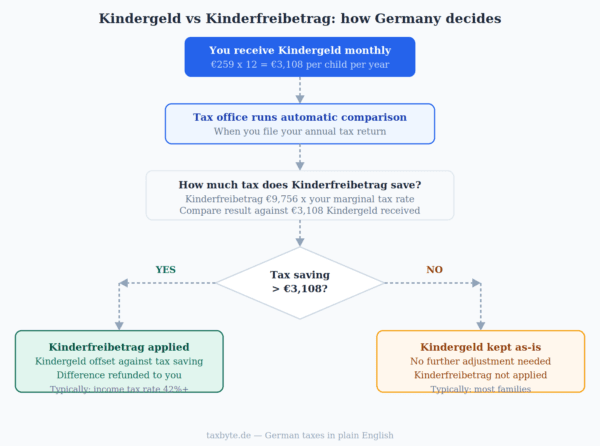
This is one of the most misunderstood aspects of German family tax law. You do not choose between Kindergeld and Kinderfreibetrag — Germany does the comparison automatically when you file your tax return.
Here is how it works:
- You receive Kindergeld monthly throughout the year (€259 × 12 = €3,108 per child)
- When you file your tax return, the tax office calculates how much tax you would save if the Kinderfreibetrag were applied instead
- If the Kinderfreibetrag saves you more than the Kindergeld you received, the difference is refunded
- If the Kinderfreibetrag saves you less, you keep the Kindergeld and the allowance is not applied
In practice, the Kinderfreibetrag only benefits higher earners — roughly those paying tax at 42% or above. For most families, Kindergeld is the better outcome and the Kinderfreibetrag calculation changes nothing.
Example: Sofia and James have one child. They received €3,108 in Kindergeld during the year. When they file their return, the tax office calculates that the Kinderfreibetrag of €9,756 would save them €2,880 in tax (at a 30% effective rate). Since €2,880 is less than the €3,108 Kindergeld already received, the Kinderfreibetrag is not applied — they simply keep the Kindergeld.
Governed by: § 31 EStG
Ehegattensplitting: joint filing for married couples
Germany allows married couples and registered civil partners to file a joint tax return — a system called Ehegattensplitting. This can result in substantial tax savings for couples with unequal incomes.
How Ehegattensplitting works
- The couple’s total income is added together
- The combined income is divided by two
- Income tax is calculated on the halved amount
- The result is doubled to get the couple’s total tax bill
Because Germany’s income tax rates are progressive, splitting the income reduces the average rate applied — the higher earner’s income is effectively taxed at a lower rate.
Example: James earns €80,000 and Sofia earns €20,000. Combined income: €100,000. Split: €50,000 each. Tax on €50,000 is approximately €12,000 — doubled to €24,000 total. If they filed separately, James would pay around €22,000 and Sofia around €2,500 — total €24,500. Joint filing saves them €500 in this example. The savings are much larger when the income gap is wider.
The benefit of Ehegattensplitting is greatest when one partner earns significantly more than the other — or when one partner has no income at all.
Governed by: § 26 EStG (joint assessment), § 32a Abs. 5 EStG (splitting formula)
🧮 See how your take-home pay changes
Calculate your net salary after tax class changes — including the effect of having children on your monthly pay.
Open Net Wage Calculator →Tax classes for married couples
Tax classes affect how much Lohnsteuer is withheld monthly — not your final tax bill. For married couples the main options are:
Class III / Class V combination
- The higher earner takes Class III — very low withholding
- The lower earner takes Class V — high withholding
- Combined, the withholding roughly matches joint tax liability
- Almost always requires filing a joint return to settle the difference
Class IV / Class IV
- Both partners in Class IV — withholding based on individual income
- Better for couples with similar incomes
- Less year-end adjustment needed
Class IV with factor (Faktorverfahren)
- Both in Class IV but with a factor applied to reflect the splitting benefit
- Most accurate monthly withholding — reduces the year-end surprise
- Underused but highly recommended for couples with unequal incomes
Governed by: § 38b EStG, § 39f EStG (factor method)
💡 Which tax class combination saves your household the most?
Compare every option side by side — including the Elterngeld impact if you are planning parental leave.
Open Tax Class Optimizer →Single parent relief (Entlastungsbetrag für Alleinerziehende)
Single parents living alone with at least one child receive a significant additional tax-free allowance:
- €4,260 per year for the first child
- €240 per year for each additional child
This relief is accessed via Tax Class II. To qualify, the single parent must genuinely live alone with the child — if a new partner moves in, entitlement ends.
Example: After separating from James, Sofia raises their two children alone. She switches to Tax Class II and receives the single parent relief of €4,260 + €240 = €4,500 per year — reducing her taxable income and her monthly Lohnsteuer withholding.
Governed by: § 24b EStG
Childcare cost deductions
Parents can deduct 80% of childcare costs for children under 14, up to a maximum of €4,800 per child per year (equivalent to €6,000 total costs at 80%)
Qualifying costs include:
- Nursery and Kita fees (Kindergarten, Krippe, Hort)
- After-school care
- Au pair costs for childcare
- Babysitter and childminder costs
What does not qualify:
- Costs for tutoring or leisure activities
- Food costs at the nursery (these must be split out from the invoice)
You need a proper invoice and bank transfer — cash payments do not qualify.
Governed by: § 10 Abs. 1 Nr. 5 EStG
Child-related extraordinary burdens
Beyond the standard childcare deduction, parents may be able to claim additional extraordinary expenses related to their children under § 33 EStG — for example, unusually high medical costs for a sick child.
For children with disabilities, the Behinderten-Pauschbetrag (disability flat-rate allowance) under § 33b EStG can be transferred to the parent if the child has no taxable income of their own.
Governed by: § 33 EStG, § 33b EStG
Maintenance payments (Unterhalt)
If you pay maintenance to an ex-partner who is the primary carer of your children, those payments may be deductible under § 33a EStG — up to €12,348 per year (the basic allowance amount for 2026).
Alternatively, if the other parent waives their share of the Kinderfreibetrag, the paying parent can claim the full child allowance.
Governed by: § 33a EStG, § 32 Abs. 6 EStG (transfer of Kinderfreibetrag)
Elterngeld: parental allowance and the tax trap
Elterngeld is Germany’s parental allowance — a state payment replacing a portion of your income when you take parental leave after the birth of a child. It is tax-free.
However Elterngeld triggers the Progressionsvorbehalt (§ 32b EStG) — meaning it does not increase your taxable income but it does push up the tax rate applied to your other income.
This means:
- Filing a tax return is mandatory in the year you receive Elterngeld
- Your effective tax rate on your salary may be higher than expected
- Planning the timing of parental leave around income levels is worth considering
For a full guide to Elterngeld, Elterngeld Plus, and how to minimise the tax impact see the Elterngeld cluster post →.
Governed by: § 32b EStG (Progressionsvorbehalt)
Key figures for families in 2026
| Item | Amount |
|---|---|
| Kindergeld per child per month | €259 |
| Kinderfreibetrag per child (total) | €9,756 |
| Kinderfreibetrag per parent | €4,878 |
| Single parent relief — first child | €4,260 per year |
| Single parent relief — each additional child | €240 per year |
| Maximum childcare deduction per child | €4,800 per year (80% of up to €6,000) |
| Maximum maintenance deduction | €12,348 per year |
| Kindergeld age limit (in education) | Up to age 25 |
Frequently asked questions
Do I receive Kindergeld automatically when my child is born?
No — you must apply for it. Applications go to the Familienkasse (part of the employment agency network). You can apply retroactively for up to six months.
My child lives abroad. Can I still claim Kindergeld?
It depends on where you and your child live and your nationality. EU citizens whose child lives in another EU country may still qualify for German Kindergeld, potentially reduced by equivalent benefits in the child’s country. Non-EU situations vary by treaty.
We are not married. Can we still benefit from Splitting?
No — Ehegattensplitting is only available to married couples and registered civil partners. Unmarried couples file separately regardless of their income situation.
I am divorcing. What happens to our tax class?
In the year of separation you can keep your existing tax class combination until the end of the year. From the following year you must switch to Tax Class I (or II if you are a single parent with custody).
Can both parents claim the Kinderfreibetrag?
Each parent receives half the Kinderfreibetrag by default (€4,878 each). One parent can transfer their share to the other — useful if one parent has no income and cannot benefit from the allowance themselves.
Related Tax Guides
- Employee Taxes — tax classes and payroll for parents
- Student Taxes — Kindergeld for adult children at university
- Health & Disability — disability allowances transferable to parents
- Household Services — childcare credits under § 35a
Related law pages on Taxbyte
- § 66 EStG — Kindergeld amounts
- § 24b EStG — Single parent relief (Entlastungsbetrag)
- § 31 EStG — Kindergeld vs Kinderfreibetrag: how the comparison works
- § 32 EStG — Child status and the Kinderfreibetrag
- § 32b EStG — The Progressionsvorbehalt and Elterngeld
- § 33 EStG — Extraordinary burdens
- § 33a EStG — Maintenance payments deduction
- § 33b EStG — Disability flat-rate allowance
- § 62 EStG — Who qualifies for Kindergeld?
- § 63 EStG — Which children qualify?
- Official sources: § 31 EStG · § 32 EStG · § 62 EStG
Related Guides
This page explains German tax law in plain English for general information purposes. It is not legal or tax advice. Tax rules change annually — always verify figures against official sources or consult a Steuerberater for your specific situation.