
Last updated: April 2026
Key Facts
- § 35a is a tax credit — reduces your tax bill directly, euro for euro
- Household services (cleaners, gardeners): 20% credit, max €4,000/year
- Craftsmen and tradespeople: 20% credit, max €1,200/year
- Only labour costs qualify — materials do not
- Cash payments disqualify — bank transfer mandatory
- Renters can also claim — via Nebenkostenabrechnung labour costs
- Combined maximum credit per household: €5,200/year
- Unused credit cannot be refunded or carried forward
On this Page
Introduction
Germany offers generous household services tax credits that allow you to directly reduce your income tax bill — not just your taxable income — for money spent on services in and around your home. This includes cleaners, gardeners, tradespeople, care workers and more.
The key word is tax credit — not tax deduction. A deduction reduces your taxable income, which indirectly reduces your tax. A credit directly reduces the tax you owe — euro for euro. This makes § 35a EStG one of the most immediately valuable reliefs in the German tax system.
This guide explains exactly what qualifies, how much you can claim, and the rules you must follow to successfully claim the credit.
Tax credit vs tax deduction: why it matters
Before diving into the details, this distinction is critical:
Tax deduction — reduces your taxable income. If you are in the 30% bracket, a €1,000 deduction saves you €300 in tax.
Tax credit (§ 35a) — reduces your tax bill directly. A €1,000 credit saves you exactly €1,000 in tax — regardless of your tax bracket.
This makes § 35a credits equally valuable for low and high earners — and far more valuable than an equivalent deduction for lower-income taxpayers.
Governed by: § 35a EStG
The three categories of § 35a EStG
§ 35a EStG divides qualifying household expenditure into three distinct categories, each with its own credit rate and annual cap.
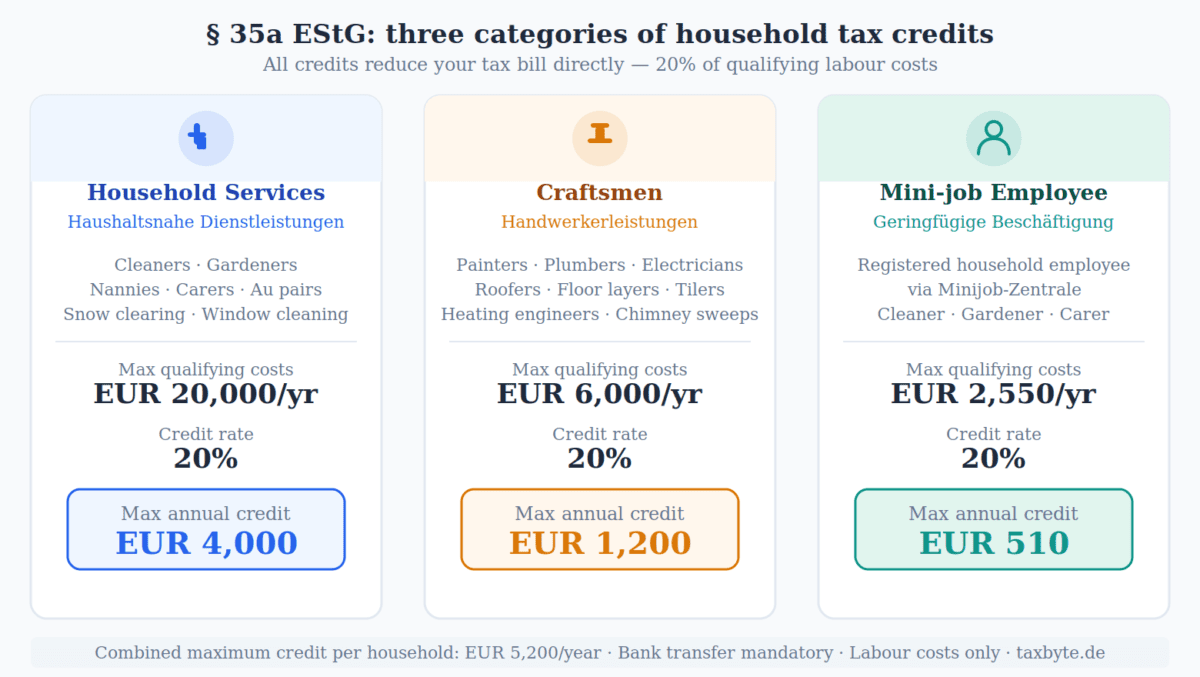
Category 1 — Household services (Haushaltsnahe Dienstleistungen)
Services performed in your home by someone who is not a family member — cleaning, gardening, childcare, elderly care, pet care, snow clearing, window cleaning.
- Credit rate: 20% of qualifying costs
- Maximum qualifying costs: €20,000 per year
- Maximum annual credit: €4,000 per year
Category 2 — Craftsmen and tradespeople (Handwerkerleistungen)
Renovation, maintenance and repair work carried out in or on your home — painting, plumbing, electrical work, heating installation, roof repairs, floor laying, window replacement.
- Credit rate: 20% of qualifying costs
- Maximum qualifying costs: €6,000 per year
- Maximum annual credit: €1,200 per year
Category 3 — Mini-job household employees (geringfügige Beschäftigung im Privathaushalt)
If you employ someone directly in your household under a registered mini-job arrangement — a cleaner, gardener or carer — a higher credit applies.
- Credit rate: 20% of qualifying costs
- Maximum qualifying costs: €2,550 per year
- Maximum annual credit: €510 per year
Note: Category 3 overlaps with Category 1 — you claim one or the other, not both, for the same employee.
What qualifies — and what does not
Household services (Category 1) — qualifies:
- House cleaning and domestic help
- Garden maintenance — mowing, planting, hedge trimming
- Window cleaning
- Snow and ice clearing
- Childcare at home (nanny, au pair)
- Elderly care and support at home
- Pet care at home
- Laundry services performed at your home
Craftsmen (Category 2) — qualifies:
- Painting and decorating (interior and exterior)
- Plumbing repairs and installation
- Electrical work
- Heating system installation and maintenance
- Roof repairs
- Floor laying and tiling
- Window and door replacement
- Kitchen installation (labour costs only)
- Chimney sweeping
- Garden landscaping involving construction work
What does NOT qualify in any category:
- Materials and supplies — only labour costs (Lohnkosten) qualify. The invoice must separate labour from materials.
- New construction — only work on existing property qualifies. Building a new extension does not.
- Work done by family members — even if they charge you.
- Cash payments — bank transfer is mandatory (see below).
- Costs already claimed as Werbungskosten or Betriebsausgaben — you cannot claim the same expense twice.
- Publicly subsidised services — if you receive a grant or subsidy for the work, the subsidised portion does not qualify.
The bank transfer rule — critical
This is the most common reason § 35a claims are rejected: cash payments do not qualify. Every payment must be made by bank transfer directly to the service provider’s own account.
From 2025, following the Jahressteuergesetz 2024, §35a Abs.5 Satz 3 EStG explicitly requires that payment goes to the account of the person or company who actually performed the service — not to an intermediary, booking platform, or debt collection agency acting on their behalf. If you pay a cleaning platform that then passes the money to the cleaner, the credit may be denied. To be safe, ensure the bank transfer goes directly to whoever issued the invoice.
You must be able to show:
- A proper invoice (Rechnung) from the service provider
- A bank transfer (Überweisung) to that provider’s own account, matching the invoice amount
Keep all invoices and bank statements. The tax office can request them during an audit.
Example: Marco pays his cleaner €150 in cash every month. He cannot claim the § 35a credit — cash payments are explicitly excluded by law. If he switches to paying by bank transfer directly to his cleaner’s account, the annual €1,800 cost would generate a credit of €360.dit of €360.
Who can claim § 35a?
Homeowners
Owners of a property used as their primary or secondary residence can claim § 35a for qualifying services at that property.
Renters
Renters can also claim § 35a — this is often overlooked. If your landlord provides services (caretaker, garden maintenance, stairwell cleaning) and charges you for them via your Nebenkostenabrechnung (utility cost statement), you can claim the labour portion of those costs.
Ask your landlord or property management for a breakdown showing the labour costs — many management companies now issue a specific § 35a certificate for tenants.
Residents of care homes
Residents of nursing homes or assisted living facilities can claim § 35a for the household services component of their fees — the portion attributable to cleaning, laundry and similar services.
One household — one credit
The § 35a credit applies per household — not per person. If two adults share a household, the combined credit cap applies once — not twice. However married couples living together share the caps between them.
How to claim § 35a in your tax return
§ 35a is claimed in your annual Einkommensteuererklärung (income tax return) on Anlage Haushaltsnahe Aufwendungen.
Steps:
- Collect all qualifying invoices for the year
- Separate labour costs from material costs on each invoice
- Confirm all payments were made by bank transfer
- Enter the qualifying labour costs on Anlage Haushaltsnahe Aufwendungen
- The tax office calculates 20% and applies it directly against your tax bill
The credit reduces your assessed income tax — if your tax bill is lower than the credit, the unused credit is lost (it cannot be refunded or carried forward).
Energy-efficient renovation credits (§ 35c EStG)
§ 35c EStG offers an additional tax credit for energy-efficient renovation measures on owner-occupied residential property — insulation, window replacement for energy efficiency, heating system upgrades, and similar measures.
This is a significant but complex area with specific technical requirements and certification obligations. For a full guide to § 35c energy renovation credits see the Energy renovation tax credit cluster post →.
Governed by: § 35c EStG
Key figures for § 35a in 2026
| Category | Max qualifying costs | Credit rate | Max annual credit |
|---|---|---|---|
| Household services | €20,000 | 20% | €4,000 |
| Craftsmen / tradespeople | €6,000 | 20% | €1,200 |
| Mini-job household employee | €2,550 | 20% | €510 |
Combined maximum credit per household per year: €5,200
Frequently asked questions
Can I claim both the household services credit and the craftsmen credit in the same year?
Yes — the two categories have separate caps and can both be claimed in the same year. You could claim up to €4,000 for household services and €1,200 for craftsmen work — a combined €5,200 credit — in a single year.
I had my kitchen fitted. Can I claim the credit?
Only the labour costs qualify — not the kitchen units or materials. Ask your kitchen fitter to issue a separate invoice for labour. The labour portion of kitchen installation qualifies under Category 2 (craftsmen).
My landlord charges me for building maintenance via Nebenkosten. Can I claim this?
Yes — request a § 35a certificate from your landlord or property manager showing the labour portion of qualifying services. Many large property managers issue these automatically with the annual Nebenkostenabrechnung.
I paid a gardener in cash. Can I still claim?
No — cash payments are explicitly excluded. Only bank transfers qualify. There are no exceptions to this rule.
Can I claim for work done on a holiday home?
Yes — § 35a applies to all residential properties you use personally, including holiday homes and second residences in Germany.
The credit is higher than my tax bill. Do I get the excess refunded?
No — the § 35a credit can only reduce your tax bill to zero. Any unused credit is lost and cannot be carried forward or refunded.
Related Tax Guides
- Employee Taxes — home office deductions for employees
- Family Taxes — childcare credits under § 35a for families
- Health & Disability — care services at home under § 35a and § 33
Related law pages on Taxbyte
- § 35a EStG — Household services tax credit: full law reference
- § 35c EStG — Energy-efficient renovation tax credit
- § 9 EStG — Work-related expenses (if home office is also involved)
- Official sources: § 35a EStG · § 35c EStG
Related Guides
This page explains German tax law in plain English for general information purposes. It is not legal or tax advice. Tax rules change annually — always verify figures against official sources or consult a Steuerberater for your specific situation.