
Last updated: April 2026
Key Facts
- Abgeltungsteuer: flat 25% tax on capital income — effective 26.375% including Soli
- Saver’s allowance: €1,000/year (single) or €2,000/year (married) — completely tax-free
- Equity ETFs: 30% of income is exempt from tax (Teilfreistellung)
- Crypto held over 12 months: completely tax-free
- Foreign broker accounts: must be declared in your annual tax return (Anlage KAP)
- Low income? Apply for Günstigerprüfung — your normal rate may beat 25%
- Share losses can only offset share gains — not ETF or dividend income
- Church members: broker automatically withholds church tax on capital income
On this Page
Introduction
Understanding how capital income tax in Germany works is essential for anyone who invests — whether through a German broker, a foreign platform, or a company pension plan. Get it wrong and you either overpay or find yourself with an unexpected bill from the Finanzamt.
Germany taxes capital income — interest, dividends, and gains from selling shares or ETFs — differently from employment income. Instead of the progressive income tax rates that apply to your salary, most capital income is subject to a flat 25% withholding tax called the Abgeltungsteuer.
This guide explains the entire German capital income tax system in in simple terms — from the flat tax rate and saver’s allowance, to ETFs, dividends, foreign accounts and loss offsetting.
What counts as capital income?
Under § 20 EStG, capital income covers a wide range of investment returns:
- Interest — from savings accounts, bonds, fixed-term deposits, P2P lending
- Dividends — from German and foreign shares
- Gains from selling shares, ETFs and investment funds
- Gains from selling bonds
- Distributions from investment funds — including ETF distributions
- Profits from certain life insurance policies
- Income from silent partnerships
One important exclusion: gains from selling private real estate are generally covered under § 22 EStG (other income) rather than § 20 EStG — with a 10-year holding period exemption. See the Rental Income and Property pillar for details.
Governed by: § 20 EStG, § 2 Abs. 1 Nr. 5 EStG
Abgeltungsteuer: the flat 25% capital gains tax
The Abgeltungsteuer (literally “settlement tax”) is Germany’s flat-rate withholding tax on capital income. It applies at a rate of 25% on all capital income — regardless of how high or low your total income is.
On top of the 25% base rate:
- Solidaritätszuschlag adds 5.5% of the tax — bringing the effective rate to 26.375%
- Church tax adds 8% or 9% of the tax if you are registered with a tax-collecting church — bringing the total to approximately 27.82% or 27.99%
For most investors the effective rate is therefore 26.375% — this is the number to use for planning purposes.
Governed by: § 32d EStG (flat rate), § 43 EStG (withholding obligation), § 43a EStG (rate)
The saver’s allowance (Freistellungsauftrag)
Every German tax resident receives an annual saver’s allowance (Sparerpauschbetrag) — a tax-free amount of capital income:
- €1,000 per year for single filers
- €2,000 per year for married couples filing jointly
Capital income below this threshold is completely tax-free. The Abgeltungsteuer only applies above it.
How to use the Freistellungsauftrag
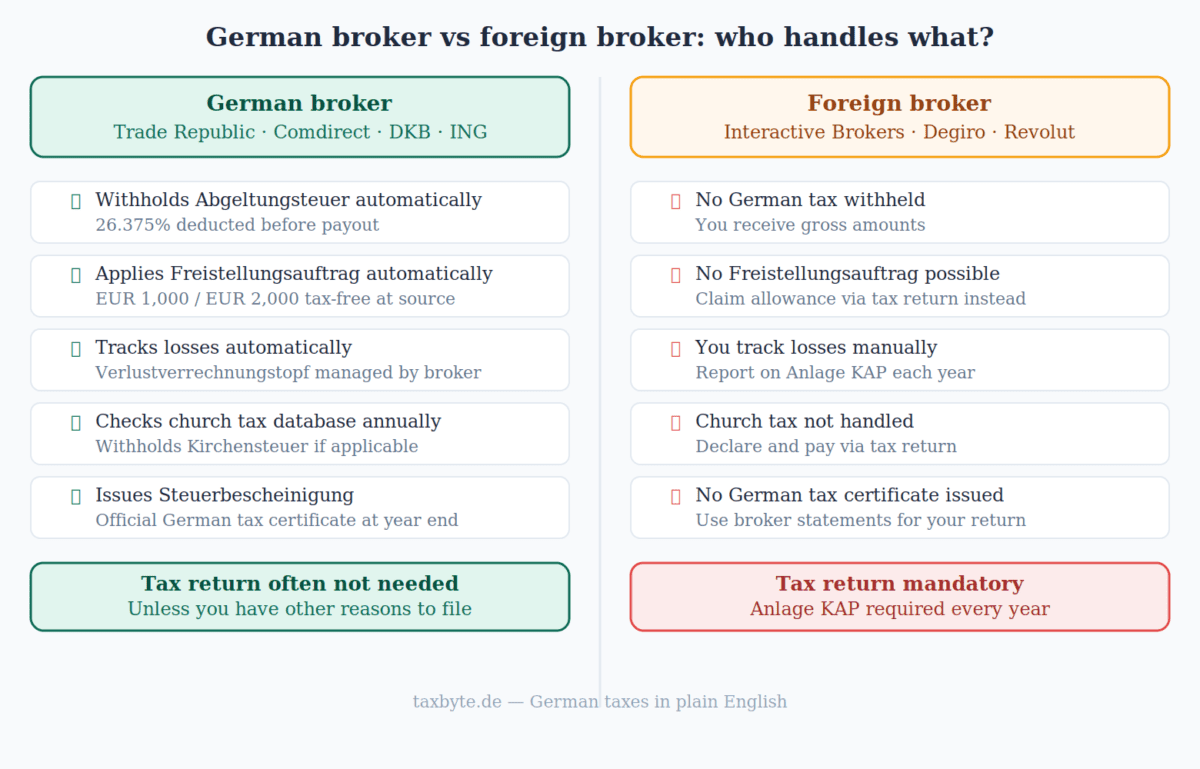
If you invest through a German broker, you submit a Freistellungsauftrag to the broker — a form telling them how much of your allowance to apply to that account. The broker then withholds no tax until your income exceeds the amount you specified.
You can split your allowance across multiple German brokers — but the total across all accounts must not exceed €1,000 (single) or €2,000 (joint).
If you invest through a foreign broker, no Freistellungsauftrag is possible. You must declare the income in your tax return and claim the allowance there.
Example: Priya holds ETFs at a German broker. She submits a Freistellungsauftrag for €1,000. During the year her ETFs generate €800 in distributions. The broker pays this out tax-free — no Abgeltungsteuer withheld, no action needed from Priya.
Governed by: § 20 Abs. 9 EStG
Shares: how capital gains are taxed
When you sell shares at a profit, the gain is subject to Abgeltungsteuer at 26.375%.
The gain is calculated as: Sale price − Purchase price − Transaction costs = Taxable gain
Key rules:
- There is no minimum holding period — gains from shares held for one day or ten years are taxed the same
- Losses from selling shares can only be offset against gains from other share sales — not against ETF gains, interest or dividends (see loss offsetting section below)
- Gains are taxed in the year of sale, not the year of purchase
Example: James bought 100 shares of a German company for €5,000 in 2024. He sells them in 2026 for €7,000. His gain is €2,000. After his €1,000 saver’s allowance, €1,000 is taxable. At 26.375%, he pays €263.75 in tax for 2026.
Governed by: § 20 Abs. 2 EStG
ETFs: how are they taxed in Germany?
ETF taxation in Germany is governed by the Investmentsteuergesetz (InvStG) — the investment fund tax law reformed in 2018. The key concept is the Vorabpauschale (advance lump-sum tax).
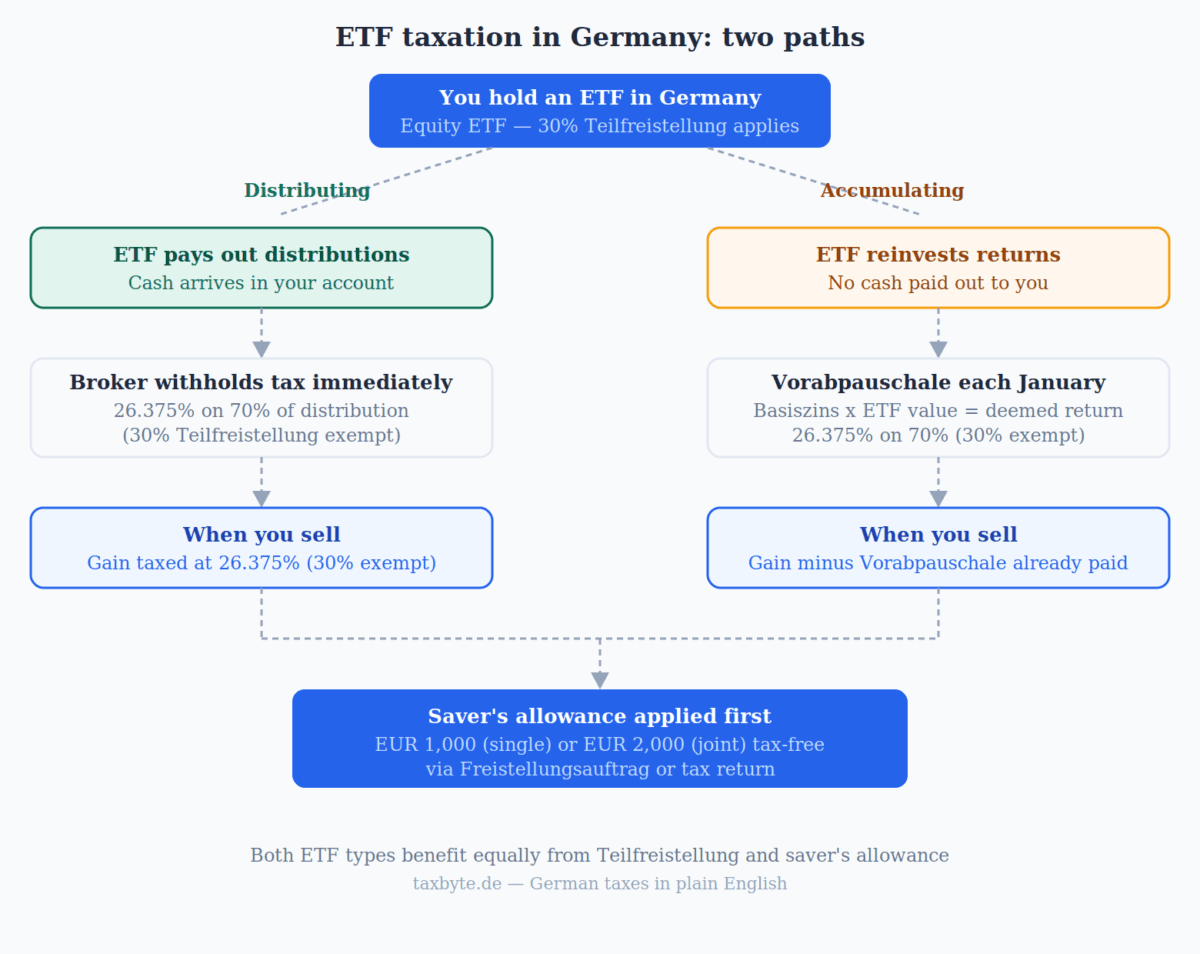
Distributions
ETF distributions (Ausschüttungen) are taxed immediately as capital income at 26.375% in the year you receive them — straightforward.
Accumulating ETFs and the Vorabpauschale
Accumulating ETFs (thesaurierend) reinvest returns rather than paying them out. Germany does not wait until you sell — instead it applies an annual Vorabpauschale: a deemed minimum return that is taxed each January, even if you received no cash.
The Vorabpauschale is calculated using:
- The Basiszins (base interest rate) set by the Bundesbank each year
- The ETF’s value at the start of the year
- A partial exemption applies — for equity ETFs, 30% of the Vorabpauschale is tax-free
When you eventually sell the ETF, the Vorabpauschale amounts already taxed are deducted from your final gain — so you do not pay twice.
Partial exemption (Teilfreistellung)
German law provides partial exemptions that reduce the taxable portion of ETF income:
| ETF type | Exemption |
|---|---|
| Equity ETFs (≥51% shares) | 30% exempt |
| Mixed funds (≥25% shares) | 15% exempt |
| Real estate funds (≥51% real estate) | 60% exempt |
| All other funds | 0% exempt |
Governed by: Investmentsteuergesetz (InvStG) 2018
Dividends: domestic and foreign
German dividends
Dividends from German companies are withheld at source by the paying company at 26.375%. If you hold the shares through a German broker, the broker handles this automatically and applies your Freistellungsauftrag.
Foreign dividends
Dividends from foreign companies are more complex. The foreign country typically withholds tax at source — often 15% under a double taxation treaty. Germany then taxes the dividend at 26.375%, but credits the foreign withholding tax against the German bill.
Important: If you receive foreign dividends through a German broker, the broker handles the credit automatically. If you use a foreign broker, you must declare the dividends in your tax return and claim the credit manually using Anlage KAP and Anlage AUS.
Example: Priya holds US shares through a German broker. The US withholds 15% dividend tax under the US-Germany tax treaty. Germany applies 26.375% but credits the 15% already paid — so Priya pays only the remaining 11.375% to Germany.
Governed by: § 20 Abs. 1 Nr. 1 EStG, § 34c EStG (foreign tax credit)
Crypto: overview
Crypto assets in Germany are treated as private assets (Privatvermögen) — not as capital income under § 20 EStG. This means:
- Gains from selling crypto held for more than one year are completely tax-free
- Gains from crypto held for less than one year are taxed as other income under § 22 EStG at your normal progressive income tax rate — not the flat 25% Abgeltungsteuer
- The €1,000 Freigrenze applies — if your total gains from all private Veräußerungsgeschäfte (crypto, gold, other assets) remain below €1,000 in the year, they are tax-free. Note: this is a threshold, not an allowance — if you exceed €999.99, the entire gain becomes taxable, not just the excess.
This is a significant difference from share taxation and creates important planning opportunities. For a full guide to crypto tax in Germany — including staking, DeFi, NFTs and exchange rules — see the Crypto tax cluster post →.
Governed by: § 22 Nr. 2, § 23 EStG
Foreign broker accounts: what you must declare
If you invest through a foreign broker (Interactive Brokers, Degiro, Trading 212, Revolut, etc.), the broker does not withhold German tax for you. You are responsible for declaring all capital income in your annual tax return using Anlage KAP.
You must declare:
- All dividends received
- All gains from selling shares or ETFs
- All interest received
- The Vorabpauschale for accumulating ETFs (calculated manually or via a tax tool)
Failure to declare foreign capital income is a serious matter — the Finanzamt increasingly receives data from foreign brokers under automatic information exchange agreements (CRS/FATCA).
Loss offsetting (Verlustverrechnung)
Germany has strict rules about which losses can offset which gains. Losses cannot be freely mixed across all capital income categories.
| Loss type | Can offset against |
|---|---|
| Share losses | Share gains only |
| General capital losses (ETFs, interest, dividends, derivatives, bond defaults) | All other capital income except share losses |
| Crypto losses | Crypto gains only (§ 23 EStG pool) |
Key rules:
- Losses that cannot be used in the current year are carried forward automatically to future years
- There is no time limit on loss carry-forwards for capital income
- Losses cannot be carried back to previous years
- German brokers track losses automatically in a Verlustverrechnungstopf (loss pot) — you can request a certificate at year end to transfer unused losses to another broker or your tax return
Important change from 2025: The Jahressteuergesetz 2024 abolished the separate restricted loss pools for derivatives (Termingeschäfte) and failed loan/bond defaults (Forderungsausfälle), which since 2021 had limited offsetting for these instruments to €20,000 per year. From 2025 onward, these losses fall into the general capital income pool and can be offset freely against all other capital income (except share gains). The restriction in §20 Abs.6 Satz 5 and 6 EStG was struck entirely. If you have carry-forward losses from these categories from prior years, they can now be fully used.
Governed by: § 20 Abs. 6 EStG
Günstigerprüfung: when your normal rate beats 25%
If your total taxable income is very low — for example if you are a student or part-year worker — your normal progressive income tax rate may be lower than 25%. In this case you can apply for the Günstigerprüfung (favourable rate check) in your tax return.
The tax office compares:
- Tax on capital income at 25% (Abgeltungsteuer)
- Tax on capital income at your normal income tax rate
If your normal rate is lower, it applies instead — and you get a refund of the excess Abgeltungsteuer withheld.
This is particularly valuable for students and low-income earners with significant investment income.
Governed by: § 32d Abs. 6 EStG
Church tax on capital income
If you are registered with a tax-collecting church, church tax applies to your capital income as well as your salary. German brokers are required to check the church tax database annually and automatically withhold church tax from your capital income if applicable.
If you do not want your broker to check your church tax status, you can file a blocking notice (Sperrvermerk) — but you must then declare and pay church tax on capital income yourself via your tax return.
Governed by: § 51a EStG
Key figures for capital income in 2026
| Item | Amount |
|---|---|
| Abgeltungsteuer flat rate | 25% |
| Effective rate including Soli | 26.375% |
| Saver’s allowance — single | €1,000 per year |
| Saver’s allowance — married/joint | €2,000 per year |
| Equity ETF partial exemption | 30% of income exempt |
| Crypto tax-free holding period | 12 months |
| Freigrenze for all private Veräußerungsgeschäfte (incl. crypto) | €1,000 per year (Freigrenze — entire gain taxable if exceeded) |
Frequently asked questions
Do I need to file a tax return if all my investments are with a German broker?
Not necessarily — if a German broker withholds Abgeltungsteuer correctly and you have no other reason to file, you do not need to. However filing is worthwhile if you have unused losses, want to claim the Günstigerprüfung, or have foreign capital income to declare.
My ETF is domiciled in Ireland. Does German tax still apply?
Yes — if you are tax resident in Germany, German tax applies to all your worldwide capital income regardless of where the fund is domiciled. Irish-domiciled ETFs (like most Vanguard and iShares funds) are very common in Germany and are subject to the same rules.
Can I offset ETF losses against share gains?
No — ETF losses and share losses are in separate pots. ETF losses can offset other general capital income (interest, dividends, other ETF gains) but not share gains specifically.
I moved to Germany mid-year. Do I pay Abgeltungsteuer on gains made before I arrived?
Germany taxes capital income from the date you became tax resident. Gains realised before you became resident in Germany are generally not taxable in Germany — though the rules depend on your specific situation and any applicable double taxation treaty.
What is the difference between a distributing and accumulating ETF for tax purposes?
A distributing ETF pays out returns annually — you pay tax when you receive the distribution. An accumulating ETF reinvests returns — you pay the Vorabpauschale annually and the remaining gain when you sell. For most long-term investors the tax difference is small, but accumulating ETFs offer a slight deferral advantage.
Related Tax Guides
- German Tax Residency — worldwide investment income for residents
- Employee Taxes — how investment income combines with salary
- Cross-Border & Expat Income — foreign broker accounts, foreign dividends
- Special Income & Exits — selling company shares, § 17 EStG
Related law pages on Taxbyte
- § 20 EStG — What counts as capital income in Germany
- § 32d EStG — The Abgeltungsteuer flat rate
- § 43 EStG — Withholding tax on capital income
- § 43a EStG — The 25% withholding rate
- § 44 EStG — Who must withhold capital gains tax
- § 45a EStG — The tax certificate (Steuerbescheinigung)
- Official sources: § 20 EStG · § 32d EStG · InvStG 2018
Related Guides
This page explains German tax law in plain English for general information purposes. It is not legal or tax advice. Tax rules change annually — always verify figures against official sources or consult a Steuerberater for your specific situation.