
Last updated: April 2026
Key Facts
- Rental income is taxed at your progressive income tax rate — not the flat 25% Abgeltungsteuer
- AfA depreciation: 2% per year (pre-2023 properties) or 3% per year (from 2023)
- New build accelerated AfA: 5% per year (degressive, from October 2023)
- Sell after 10 years — capital gain is completely tax-free
- Primary residence: tax-free if used as your primary residence either for the entire ownership period, or in the year of sale and the two preceding calendar years
- Rental losses can offset your salary and other income in the same year
- Rent to family at less than 66% of market rent → deductions may be disallowed
- Non-resident landlords must file a German tax return for German property
On this Page
Introduction
Unlike capital income which is taxed at a flat 25%, rental income tax in Germany is subject to your normal progressive income tax rate. This means rental income sits on top of your salary and is taxed at your marginal rate — potentially up to 42% or 45%. Owning a rental property in Germany comes with real tax advantages — but also real obligations.
The good news: Germany allows landlords to deduct a wide range of expenses, including a generous annual depreciation allowance that can significantly reduce — or even eliminate — your taxable rental income for years.
This guide explains everything property owners need to know about rental income taxes in Germany — from what you can deduct, to the 10-year speculation tax rule, to vacation rentals and non-resident landlords.
What counts as rental income?
Under § 21 EStG, rental income covers income from letting:
- Residential property — flats, houses, rooms
- Commercial property — offices, retail units, warehouses
- Land — agricultural land, building plots
- Movable property — equipment, vehicles (in certain circumstances)
- Rights — licences to use intellectual property or land rights
The key principle: any income you receive in exchange for allowing someone else to use your property or rights is rental income.
What is not rental income:
- Gains from selling property — these fall under § 23 EStG (speculative gains) or are tax-free if held long enough
- Income from vacation rentals classified as a commercial operation — these may be trade income under § 15 EStG instead
Governed by: § 21 EStG, § 2 Abs. 1 Nr. 6 EStG
How rental income is taxed
Unlike dividends and share gains — which are taxed at the flat 26.375% Abgeltungsteuer — rental income is taxed at your personal progressive income tax rate under § 32a EStG.
This means:
- Rental income is added to your other income (salary, freelance income, etc.)
- The combined total determines your marginal tax rate
- Rental income at the top of your income stack is taxed at your highest rate
Example: Helga earns €40,000 from her pension and €12,000 in net rental income after deductions. Her total taxable income is €52,000. The rental income at the margin is taxed at approximately 35% — not the flat 25% that would apply to dividends.
This makes deductions extremely valuable for landlords — every euro of deductible expense saves tax at your marginal rate.
Governed by: § 21 EStG, § 32a EStG
What landlords can deduct
Germany allows landlords to deduct all expenses that are directly connected to generating rental income (Werbungskosten). The most important categories are:
Mortgage interest
Interest on loans taken out to purchase or renovate the property is fully deductible. Note: only the interest portion is deductible — not the capital repayment.
Property management costs
- Estate agent fees for finding tenants
- Property management company fees
- Letting platform fees
Maintenance and repairs
Costs to maintain the property in its current condition are deductible in the year incurred. Major improvements that increase the property’s value or extend its useful life must be depreciated instead (see AfA section below).
Non-recoverable operating costs (Nebenkosten)
Costs you pay as landlord that you cannot pass on to the tenant:
- Building insurance
- Property tax (Grundsteuer)
- Maintenance fund contributions (Hausgeld) for owner-occupied buildings
- Garden and communal area maintenance
- Lift maintenance
Travel costs
Trips to inspect the property, meet tenants, or deal with maintenance — deductible at €0.30 per km.
Professional fees
- Tax advisor fees relating to your rental income
- Legal fees for tenant disputes
Advertising costs
Costs of advertising the property to find tenants.
Governed by: § 9 EStG (Werbungskosten)
Depreciation (AfA): your most valuable deduction
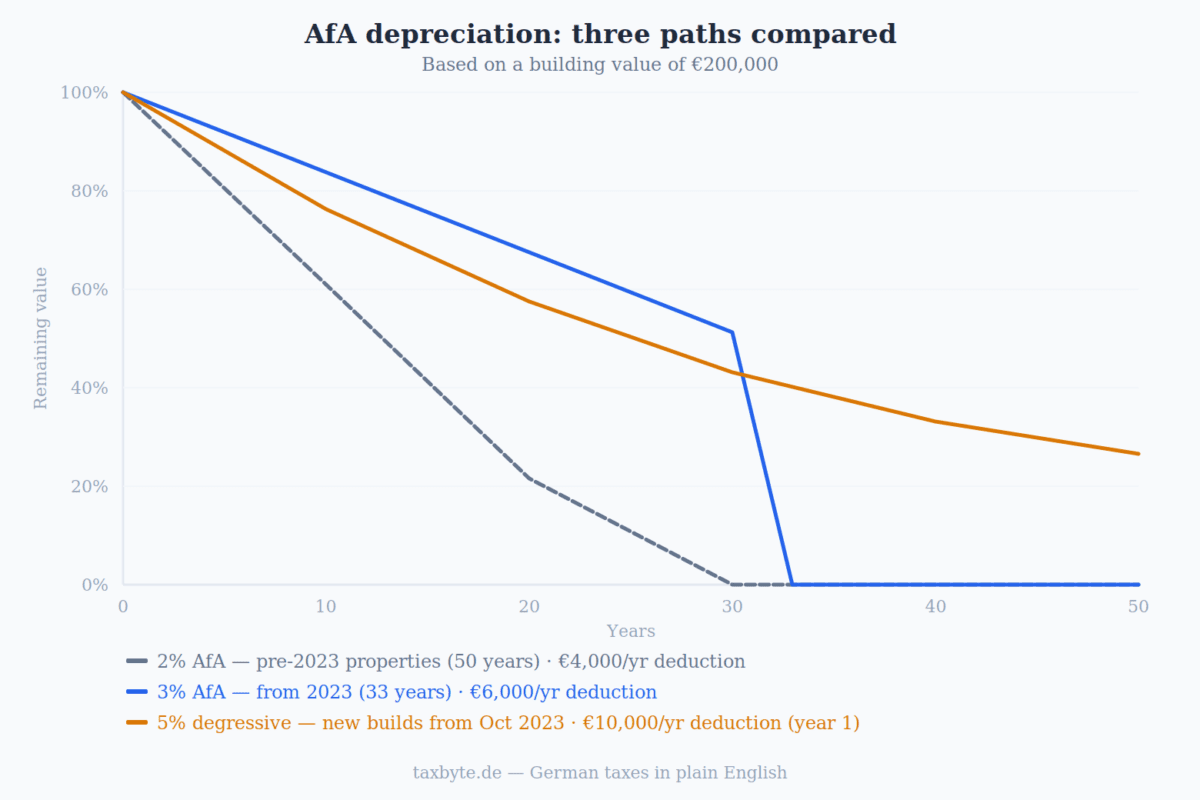
AfA (Absetzung für Abnutzung) — depreciation — is the most powerful tax tool available to German landlords. It allows you to deduct a portion of the building’s purchase price every year, even though you are not actually spending that money.
Standard AfA rate
For residential properties purchased or completed after 1 January 2023, the AfA rate is 3% per year of the building’s value — meaning the building is fully written off over approximately 33 years.
For properties purchased before 1 January 2023, the standard rate is 2% per year — written off over 50 years.
What is depreciated — and what is not
Only the building is depreciated — not the land. When you purchase a property, you must split the purchase price between land and building. The building portion is depreciated; the land portion is not.
The land/building split is typically based on the local land value (Bodenrichtwert) published by local authorities. For properties in expensive cities like Munich or Berlin, the land portion can be 50% or more of the total purchase price — significantly reducing the depreciable base.
Example: Helga buys a flat in Berlin for €400,000. The land value is assessed at €180,000. The building value is €220,000. At 3% AfA, she can deduct €6,600 per year — regardless of whether she actually spends anything on the building.
Accelerated depreciation for new builds
For new residential buildings built after 1 October 2023 and used for rental purposes, a special degressive AfA of 5% per year applies in the first years — significantly front-loading the tax benefit for investors in new construction.
Governed by: § 7 EStG
The 10-year speculation tax rule (Spekulationssteuer)
When you sell a property in Germany, the gain may or may not be taxable — depending entirely on how long you owned it.
The rule
If you sell a property that you have not used as your primary residence and you owned it for less than 10 years, the gain is taxable as a speculative gain under § 23 EStG at your normal progressive income tax rate.
If you owned it for 10 years or more, the gain is completely tax-free.
Primary residence exception
There are two routes to tax-free sale of an owner-occupied property, both under §23 Abs.1 Nr.1 Satz 3 EStG:
Route 1 — entire ownership period: If the property was used exclusively as your primary residence from purchase to sale, the gain is completely tax-free regardless of how long you owned it.
Route 2 — year of sale plus two preceding calendar years: If you used the property as your primary residence in the year of sale and the two calendar years immediately before it, the gain is tax-free. Three full calendar years of use are not required — a few days in December of the first year and January of the sale year can satisfy this test. But the three calendar years must all be covered.
In both cases, the exemption applies regardless of the 10-year holding period. A property that was previously rented and then owner-occupied can also qualify under Route 2.
How the gain is calculated
Taxable gain = Sale price − Purchase price − Purchase costs − Improvement costs − Selling costs − AfA already claimed
Important: AfA claimed during the ownership period is deducted from your cost base — meaning the more depreciation you claimed, the higher your taxable gain on sale.
Example: James bought a flat in Munich in 2018 for €500,000 and sells it in 2026 for €680,000 — after 8 years. He never lived there. His gain of €180,000 (minus costs and AfA adjustments) is fully taxable at his marginal rate. Had he waited until 2028 — 10 years — the entire gain would have been tax-free.
Governed by: § 23 EStG
Renting part of your home
If you rent out part of your primary residence — a room, a floor, or a granny flat — you are entitled to deduct a proportional share of your household costs:
- A proportional share of mortgage interest or rent
- A proportional share of utilities, insurance, and maintenance
- AfA on the portion of the building used for rental
The proportion is based on the floor area rented as a percentage of total floor area.
Important: If you rent out a room in your home while also using it as a home office, the tax treatment becomes complex — consult a Steuerberater for your specific situation.
Vacation rentals and Airbnb
Short-term vacation rental income (Ferienwohnungen) is generally treated as rental income under § 21 EStG — subject to the same progressive tax rates and deduction rules as long-term rentals.
However if the vacation rental activity crosses the threshold of a commercial operation (gewerbliche Vermietung) — for example because you provide hotel-like services such as breakfast, daily cleaning, or concierge — it may be reclassified as trade income under § 15 EStG. This triggers trade tax (Gewerbesteuer) in addition to income tax.
VAT note: Short-term rentals may also trigger a VAT obligation if your annual turnover exceeds the Kleinunternehmergrenze (€25,000 from 2025). This is a separate obligation from income tax.
Governed by: § 21 EStG, § 15 EStG
Rental losses: offsetting against other income
If your rental expenses exceed your rental income — for example in the early years when you have high AfA and mortgage interest — you make a rental loss. This loss can be offset against your other income (salary, freelance income) in the same year, reducing your overall tax bill.
This is one of the most attractive features of property investment in Germany — rental losses directly reduce your taxable salary income.
Important restriction: If the tax office concludes that you are not genuinely pursuing profit from the rental — for example if you rent to family members at a significant discount — they may classify the activity as Liebhaberei (hobby activity) and disallow all deductions. To avoid this, charge at least 66% of the local market rent to family members.
Governed by: § 21 Abs. 2 EStG (Liebhaberei rule)
Non-resident landlords: property in Germany
If you own rental property in Germany but are not tax resident here, Germany still taxes your German rental income — as a limited taxpayer under § 49 EStG.
Key points for non-resident landlords:
- German rental income must be declared in a German tax return
- You are entitled to deduct the same expenses as resident landlords
- The basic tax-free allowance (Grundfreibetrag) generally does not apply to limited taxpayers
- Double taxation treaties may provide relief if you also pay tax on the same income in your country of residence
Governed by: § 49 Abs. 1 Nr. 6 EStG
Key figures for landlords in 2026
| Item | Amount |
|---|---|
| AfA rate — properties before 2023 | 2% per year |
| AfA rate — properties from 2023 | 3% per year |
| Accelerated AfA — new builds from Oct 2023 | 5% per year (degressive) |
| Speculation tax holding period | 10 years |
| Primary residence exemption | Entire ownership period as primary residence — OR — year of sale + 2 preceding calendar years |
| Minimum rent to family (avoid Liebhaberei) | 66% of market rent |
| VAT threshold (Kleinunternehmer) | €25,000 per year |
Frequently asked questions
I rent out my flat while working abroad. Do I still pay German tax on it?
Yes — rental income from German property is always taxable in Germany, regardless of where you live. You must file a German tax return declaring the rental income even as a non-resident.
Can I deduct the full purchase price of the property?
No — only the building portion is depreciated via AfA, and only at the annual rate (2% or 3%). The land value is never deductible. Major improvements are added to the depreciable base and written off over the remaining useful life.
I renovated immediately after buying. Can I deduct the costs?
Renovation costs incurred within three years of purchase that exceed 15% of the building’s purchase price are classified as anschaffungsnahe Herstellungskosten — they must be depreciated via AfA rather than deducted immediately. Plan renovation timing carefully.
My tenant stopped paying rent. Can I deduct the unpaid rent?
No — you only declare rent actually received. Unpaid rent you were never able to collect is simply not included in your income. However costs you incurred trying to recover the rent (legal fees) are deductible.
Do I pay Gewerbesteuer on my rental income?
Generally no — private rental activity is not subject to trade tax. Only if the rental is classified as a commercial operation (gewerbliche Vermietung) does Gewerbesteuer apply.
Related Tax Guides
- German Tax Residency — non-resident landlords with German property
- Cross-Border & Expat Income — expats owning German property from abroad
- Special Income & Exits — selling property, the 10-year rule and gains
Related law pages on Taxbyte
- § 7 EStG — Depreciation (AfA): how building costs are written off
- § 9 EStG — Deductible expenses for landlords (Werbungskosten
- )§ 21 EStG — What counts as rental income?
- § 23 EStG — Speculation tax and the 10-year rule
- § 49 EStG — German-source income for non-resident landlords
- Official sources: § 21 EStG · § 23 EStG · § 7 EStG
Related Guides
This page explains German tax law in plain English for general information purposes. It is not legal or tax advice. Tax rules change annually — always verify figures against official sources or consult a Steuerberater for your specific situation.