
Last updated: April 2026
Key Facts
- Medical costs only deductible above your zumutbare Belastung threshold — typically 5–7% of income
- Disability flat-rate (Behinderten-Pauschbetrag): €384–€7,400/year depending on GdB — no receipts needed
- Care flat-rate (Pflege-Pauschbetrag): €600–€1,800/year for unpaid home carers
- Disability allowance can be transferred to parents if child cannot use it
- Nursing home costs partly deductible — minus notional accommodation value
- You can claim either flat rate or actual costs — whichever is higher
- § 35a household services credit also available for care services at home
On this Page
Introduction
Germany’s tax system recognises that certain unavoidable costs — medical expenses, disability-related costs, care costs — reduce a person’s ability to pay tax just as much as any other expense. The health and disability tax deductions available under §§ 33 and 33b EStG can significantly reduce your tax bill if you or a family member has a disability, chronic illness, or high medical costs.
This guide explains every major health, disability and care deduction available in Germany in plain English — including the flat-rate allowances that require no receipts, and the rules for claiming actual costs when they exceed the flat rates.
Außergewöhnliche Belastungen: extraordinary burdens (§ 33 EStG)
Außergewöhnliche Belastungen (extraordinary burdens) is the umbrella category for unavoidable personal expenses that go beyond what the average taxpayer faces. Medical costs, care costs, and disability-related expenses all fall here.
To qualify as an extraordinary burden, the expense must be:
- Unavoidable — you had no reasonable way to avoid it
- Extraordinary — larger than what the average person in your situation would face
- Not already covered by insurance, employer contributions or state benefits
Governed by: § 33 EStG
The zumutbare Belastung: the threshold you must exceed
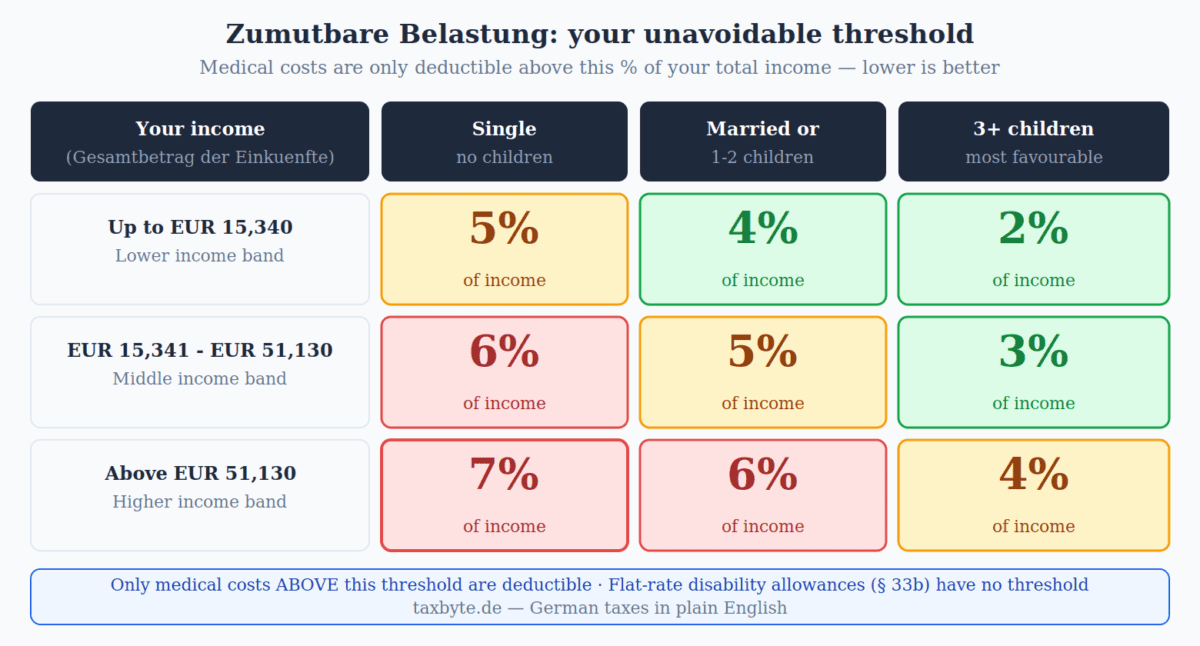
This is the most misunderstood aspect of extraordinary burden deductions. Germany does not allow you to deduct the full amount of qualifying expenses — only the amount that exceeds your zumutbare Belastung (reasonable personal burden threshold).
The threshold is calculated as a percentage of your total income (Gesamtbetrag der Einkünfte) and depends on your income level, marital status and number of children:
| Income | Single, no children | Married or 1-2 children | 3+ children |
|---|---|---|---|
| Up to €15,340 | 5% | 4% | 2% |
| €15,341 – €51,130 | 6% | 5% | 3% |
| Above €51,130 | 7% | 6% | 4% |
Example: Lena is single with no children and earns €40,000. Her zumutbare Belastung is 6% of €40,000 = €2,400. If her qualifying medical expenses total €3,500, only €1,100 (€3,500 − €2,400) is deductible.
This threshold means that small or moderate medical expenses often produce no tax benefit — only costs significantly above the threshold make a difference.
Important: The zumutbare Belastung does not apply to the flat-rate disability and care allowances under § 33b EStG — those are deducted in full without any threshold.
Governed by: § 33 Abs. 3 EStG
What medical expenses qualify under § 33 EStG?
Qualifying medical expenses include:
- Doctor and specialist fees not covered by insurance
- Prescription medicines — the portion not reimbursed by your health insurer
- Hospital costs — the statutory daily co-payment (Zuzahlung)
- Dental costs — crowns, implants, orthodontics where the health insurer does not cover the full cost
- Glasses and contact lenses — in certain circumstances
- Medical aids and devices — wheelchairs, hearing aids, orthopaedic shoes (not covered by insurer)
- Therapies prescribed by a doctor — physiotherapy, psychotherapy, speech therapy
- Transport costs to medical appointments — at €0.30 per km
- Costs of a medically necessary cure or rehabilitation (Kur)
What does not qualify:
- Gym membership — even if recommended for health reasons
- Cosmetic procedures without medical necessity
- Vitamins and supplements
- Costs already reimbursed by insurance
Governed by: § 33 EStG
Disability flat-rate allowance (Behinderten-Pauschbetrag)
The Behinderten-Pauschbetrag under § 33b EStG is a flat-rate annual deduction for people with a recognised disability. It replaces the need to track and document individual disability-related costs — you simply claim the flat rate and no receipts are required.
How much is the Behinderten-Pauschbetrag in 2026?
The amount depends on your degree of disability (Grad der Behinderung — GdB), which is assessed by the Versorgungsamt and recorded in your Schwerbehindertenausweis (disability ID card):
| Degree of disability (GdB) | Annual flat-rate allowance |
|---|---|
| GdB 20 | €384 |
| GdB 30 | €620 |
| GdB 40 | €860 |
| GdB 50 | €1,140 |
| GdB 60 | €1,440 |
| GdB 70 | €1,780 |
| GdB 80 | €2,120 |
| GdB 90 | €2,460 |
| GdB 100 | €2,840 |
| Blind or helpless (hilflos) | €7,400 |
Who qualifies?
Anyone with a recognised degree of disability of at least GdB 20, or anyone receiving a war injury pension, or anyone certified as blind or helpless (hilflos).
New from 2026 — digital verification: For new GdB assessments or changes to an existing GdB from 1 January 2026, the Versorgungsamt transmits your disability data directly to the Finanzamt electronically — you no longer need to submit paper certificates for new or changed determinations. To enable this, you must include your Steuer-Identifikationsnummer (Tax ID) in your GdB application and confirm consent to electronic transmission. Without this, the electronic transfer cannot take place and the Pauschbetrag may not be processed automatically.
GdB certificates issued before 1 January 2026 remain valid and continue to be accepted in the usual way — this change applies only to new assessments and changes made from 2026 onward.
Transfer to parents or spouse
If a disabled person has insufficient income to use the allowance themselves, it can be transferred to a parent or spouse. This is particularly relevant for disabled children — parents can claim the child’s Behinderten-Pauschbetrag against their own income.
Governed by: § 33b EStG
Care flat-rate allowance (Pflege-Pauschbetrag)
The Pflege-Pauschbetrag is a flat-rate deduction for people who personally care for a disabled or elderly person at home — without receiving payment for the care.
Amounts for 2026
| Care level (Pflegegrad) | Annual flat-rate allowance |
|---|---|
| Pflegegrad 2 | €600 |
| Pflegegrad 3 | €1,100 |
| Pflegegrad 4 or 5 / hilflos | €1,800 |
Who can claim?
The carer — not the person being cared for. To qualify:
- You must care for the person personally — not through a paid carer
- The care must take place in either your home or the cared-for person’s home
- You must receive no payment for the care
- The person being cared for must have a recognised Pflegegrad of 2 or above, or be certified as hilflos
Multiple carers sharing responsibility for the same person split the allowance between them.
Governed by: § 33b Abs. 6 EStG
Nursing home and assisted living costs
If you or a dependent family member lives in a nursing home or assisted living facility, the costs may be deductible — but the rules depend on why the person is in the home.
Care necessity (Pflegebedürftigkeit)
If the nursing home placement is medically necessary — the person has a recognised Pflegegrad — the costs qualify as extraordinary burdens under § 33 EStG, subject to the zumutbare Belastung threshold.
The deductible amount is the total cost minus the home’s value equivalent — Germany assumes that living in a nursing home replaces normal living costs, so a notional amount for accommodation and food is deducted from the qualifying costs.
Age alone (no care necessity)
If the move to assisted living is purely age-related with no recognised care need, only the care service component of the fees qualifies — not the accommodation and food costs.
§ 35a credit for household services in nursing homes
Residents of nursing homes can also claim the § 35a household services credit for the labour component of cleaning, laundry and domestic services included in their fees — separate from the § 33 deduction.
Combining flat-rate allowances with actual costs
You can claim either the flat-rate Behinderten-Pauschbetrag or actual documented disability-related costs — whichever is higher. You cannot claim both for the same costs.
If your actual costs significantly exceed the flat rate, it is worth tracking receipts and claiming actual costs instead. In practice the flat rate is more convenient for most people.
Key figures for 2026
| Item | Amount |
|---|---|
| Behinderten-Pauschbetrag — GdB 50 | €1,140 per year |
| Behinderten-Pauschbetrag — GdB 100 | €2,840 per year |
| Behinderten-Pauschbetrag — blind/hilflos | €7,400 per year |
| Pflege-Pauschbetrag — Pflegegrad 2 | €600 per year |
| Pflege-Pauschbetrag — Pflegegrad 3 | €1,100 per year |
| Pflege-Pauschbetrag — Pflegegrad 4/5/hilflos | €1,800 per year |
| Zumutbare Belastung — single, no children, income €40k | 6% of income = €2,400 |
Frequently asked questions
I wear glasses. Can I deduct the cost?
Only in limited circumstances — if a doctor prescribed them and they are medically necessary beyond the standard correction. Routine glasses and contact lenses are generally not deductible unless exceptional circumstances apply.
My child has a disability. Can I claim the Behinderten-Pauschbetrag?
Yes — if the child cannot use the allowance themselves due to insufficient income, you can transfer it to your own tax return. Both parents can each claim half, or one parent can claim the full amount if the other has no income.
I care for my elderly mother at home. She has Pflegegrad 3. What can I claim?
You can claim the Pflege-Pauschbetrag of €1,100 per year — no receipts needed. If your actual care-related costs exceed this, you can claim actual costs instead under § 33 EStG, subject to the zumutbare Belastung threshold.
My health insurance covers most of my medical costs. Can I still claim?
Only costs not reimbursed by your insurer qualify. The statutory co-payments (Zuzahlungen) you pay out of pocket do qualify — these can add up over a year, especially for people with chronic conditions.
I have a GdB of 50. Do I automatically get the Behinderten-Pauschbetrag?
Not automatically — you must claim it in your tax return on Anlage Außergewöhnliche Belastungen. But once claimed, it applies every year without needing to reapply, as long as your GdB remains the same.
Related Tax Guides
- Family Taxes — transferring disability allowances to parents
- Household Services — § 35a credits for care services at home
- Retirement & Pensions — care costs and nursing home deductions for retirees
Related law pages on Taxbyte
- § 33 EStG — Extraordinary burdens: medical and care costs
- § 33a EStG — Maintenance and support payments
- § 33b EStG — Disability and care flat-rate allowances
- Official sources: § 33 EStG · § 33b EStG
Related Guides
This page explains German tax law in plain English for general information purposes. It is not legal or tax advice. Tax rules change annually — always verify figures against official sources or consult a Steuerberater for your specific situation.